
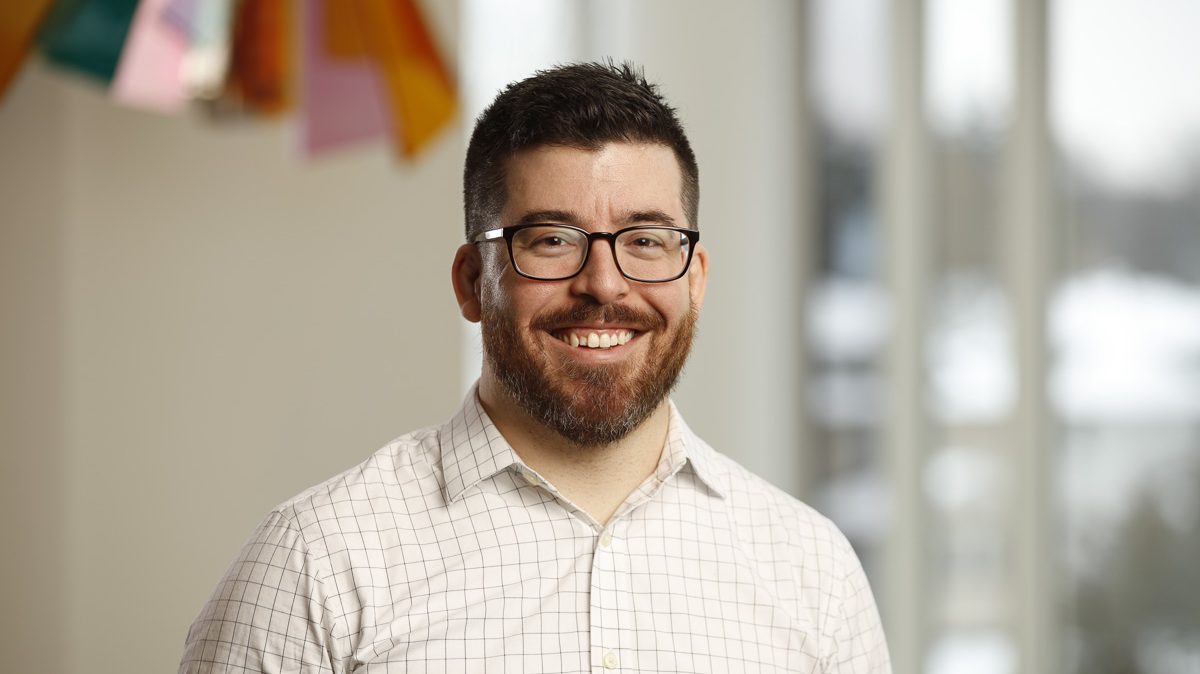
New OICR Investigator discusses coming home to Ontario, the link between antioxidants and cancer, and how he wants his research to help improve your diet.
Dr. Isaac Harris was recently recruited to McMaster University and the Centre for Discovery in Cancer Research (CDCR) from the University of Rochester Medical Center in New York. The new OICR Investigator and expert in antioxidants and cancer spoke to OICR News about his decision to relocate to Hamilton and how he sees his research having an impact on cancer prevention, detection and treatment.
What attracted you to McMaster?
I grew up in Ottawa and did my undergraduate and graduate studies at the University of Toronto and at the Princess Margaret Cancer Centre, so it was always a dream to be able to come back to Canada. McMaster was the perfect place professionally. They have really great cancer biologists at the CDCR, both established and up and coming, such as Katie Houlahan. They also have huge expertise in metabolism research with top-notch investigators such as Greg Steinberg, who co-directs the Centre for Metabolism, Obesity and Diabetes Research. Finally, McMaster has amazing facilities, including high-throughput instrumentation at the Centre for Microbial Chemical Biology. My research intersects all of those areas, so I knew that coming here I’d be able to hit the ground running and take my research to a much higher level.
Why was it the right time for you to make the move back to Canada and Ontario?
I think it is an amazing time for cancer research in Ontario and Canada. Canada is a great place to be a cancer researcher; you can do really high-level research here while being in, what’s for me at least, the perfect place to live. In my career I have been fortunate to have trained and conducted research around the world and I can tell you that the level of science that’s happening here is as high as anywhere. On top of that, I think we have a uniquely strong network of collaboration, which is a key to success.
What are the big scientific questions you and your lab are trying to answer and why do they matter in the context of cancer?
We study antioxidants and their roles in health and disease, including cancer. In the public domain we see that there is a fairly widespread belief that antioxidants prevent cancer. However, the evidence is actually to the contrary.
When I started my graduate studies at Princess Margaret, they had just ended a massive clinical trial of antioxidants in cancer. Amongst the more than 35,000 men enrolled they found that those on antioxidant supplements were actually more likely to develop prostate cancer.
This got me interested in, absent supplements, how does the cancer make its own antioxidants? The clinical trial was saying, ‘more antioxidants, more cancer’ and so we were thinking – as a therapeutic approach – ‘less antioxidants, less cancer’. The research has shown that to indeed be the case – we can stop the growth of and/or sensitize cancer cells by blocking these antioxidant pathways. We’re also looking into a potential diagnostic approach that would allow cancers to be detected by their abundance of antioxidant production.
What do you think the general public should know about antioxidant supplements, especially when it comes to cancer?
First, we need to understand that the interest in these supplements is driven by people wanting to have control of their health, in this case to prevent cancer or aid in its treatment. And I think there’s this common misconception that at worst the supplements just do nothing and you are no worse off. However, the science clearly shows that there is in fact usually no benefit when it comes to cancer and that some of these supplements may be detrimental. I think that right now we are seeing a lag between what the research says and how society responds to those findings, not dissimilar to how it took many years for anti-smoking measures to catch up with the established science.
How do you hope that your research will help inform that conversation and help people make better decisions about their health?
There are two primary ways that our research plays a role here. One is informing the public about the role that diet plays in cancer, and the other is building evidence to support the regulation of supplements.
By continuing to add evidence about the role of antioxidants in cancer, and how certain foods such as those with animal-based fats can fuel cancers, we hope to help people make better diet and lifestyle choices. We need to drive home the importance of what we eat when it comes to cancer and the more evidence we have, the stronger we can make that point.
Just as importantly, we need to use that same evidence to push for regulation of these supplements. Right now, there is very little oversight of what’s on the market and no proof of efficacy is required to sell a supplement. At the very least, we need to make sure that people are properly informed about what they are putting into their bodies and clearly warned of the risks.
Finally, beyond diet and supplements, we believe these antioxidants are critical to cancer growth and progression. We think that we can potentially identify cancers by monitoring antioxidant levels in the body. Further, we believe that by developing new drugs that block these antioxidants, we can slow or stop cancer growth.
How will being an OICR Investigator help advance this research?
The support that OICR is providing is critical to getting established here in Ontario and, as I said earlier, really taking what we have been doing to the next level. But being successful in that does not just come down to funding – it’s really about the environment, expertise and people around you.
It’s early days, but I can already tell that being a part of the OICR community will pay dividends for my lab, especially when it comes to forging the inter-institutional and cross-disciplinary collaborations that are so important to research today. On top of that OICR’s translational focus can help ensure that our work is really making a difference in the health of individuals and our communities.