Drs. David Uehling and Jai Ramnauth explain proximity-induced drugs and how their nimble, multidisciplinary team is uniquely situated in the field
A new form of cancer drugs move beyond simply blocking cancer-driving proteins to destroying them altogether, and the OICR Drug Discovery Program is helping to lead the charge in unlocking the massive potential of proximity-induced drugs, especially for cancers that are currently hard to treat.
“Proximity-induced drugs work almost like a matchmaker for two proteins that wouldn’t normally be together,” says Dr. David Uehling, Interim Scientific Lead, Therapeutic Innovation and Drug Discovery at OICR. “When you bring them together, new things happen in the cell that a single drug could never do.”
Most cancer drugs today work by attaching to a single protein and shutting down its activity, but this approach has its limits. Many important cancer-driving proteins don’t have the kinds of structures that traditional drugs can easily target. These so-called “undruggable” proteins have long been out of reach. Proximity-induced drugs offer a fundamentally different approach. Rather than acting on one target alone, these therapies are designed to bring two proteins into close proximity, triggering new biological effects. In some cases, that effect is especially powerful: one protein is recruited to destroy the other. “Instead of inhibition, it’s destruction. That’s the shift,” says Uehling.

Cells are constantly recycling their components, marking unwanted proteins for disposal and breaking them down. Many proximity-based drugs tap into this natural system. “They act like a tag that marks a protein for the trash,” explains Dr. Jai Ramnauth, Associate Director, Drug Discovery. “It’s essentially directing the cell’s garbage disposal system to remove something we don’t want.” This process, known as targeted protein degradation, can be far more effective than simply blocking a protein’s activity. “It’s like a mega-boost of inhibition—we’re not just blocking the protein, we’re getting rid of it,” Uehling adds.
One of the most exciting aspects of proximity-induced drugs is their ability to reach targets that have historically been inaccessible. By bringing proteins together, these drugs can create entirely new interaction surfaces—effectively building a new target on the fly. “It’s an entry point into making undruggable proteins druggable—and that’s super exciting,” says Uehling. That capability could expand the range of diseases that can be treated, particularly in cancers where current therapies fall short.
Momentum in the field is building quickly. Several proximity-based therapies are now in clinical trials, and early versions of these approaches have begun to receive regulatory approval. Researchers expect they will become increasingly common in the years ahead. “This is going to be a huge new tool in the toolbox,” says Uehling. “It’s not replacing traditional drugs—it’s expanding what we can do.”
OICR Drug Discovery Program researchers are helping to push this field forward by developing both new drug candidates and the tools needed to create them more efficiently. The work builds on years of expertise in medicinal chemistry and the design of molecules that bind to specific proteins. “If we don’t have a good molecule to start with, we can’t do any of this,” says Uehling. “Traditional drug discovery and proximity approaches go hand in hand.” From that foundation, the team has developed a specialized toolkit that allows them to design proximity-induced drugs more rapidly.
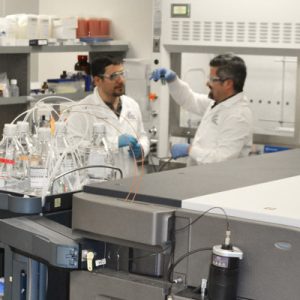
The strength of the Drug Discovery team goes beyond the unique tools at their disposal and includes a concentration of expertise in key areas both within the team and amongst close collaborators. Researchers develop proprietary molecules that bind to cancer targets, test them in biological systems to understand how they behave in cells, and use structural biology tools to visualize exactly how they interact at the molecular level. “We can get a snapshot of exactly how these molecules interact with proteins,” says Ramnauth. This integrated approach allows the team to quickly evaluate and refine new ideas. “It’s a network that reinforces our advantage—bringing all these capabilities together,” he adds.
Although still in early stages, OICR’s proximity-based approaches are already showing promise across multiple cancers. Some projects are being explored in breast, colon and pancreatic cancers, while others take an immuno-oncology approach that could apply across a wide range of solid tumours. “We’re seeing promising results in areas with significant unmet need,” says Uehling.
Proximity-induced drugs are unlikely to replace traditional therapies in the near future, but they are poised to become an essential complement. “They’re going to become much more commonplace,” Uehling says. “It’s a big expansion into territory we couldn’t access before.” For the researchers involved, that opportunity is a powerful motivator. “We’re incredibly excited about this,” he says. “It’s accelerating everything we do.” Ramnauth agrees, noting that the work reflects the broader culture of the program. “It speaks to how nimble we are—how quickly we can move into new areas and make an impact.”