
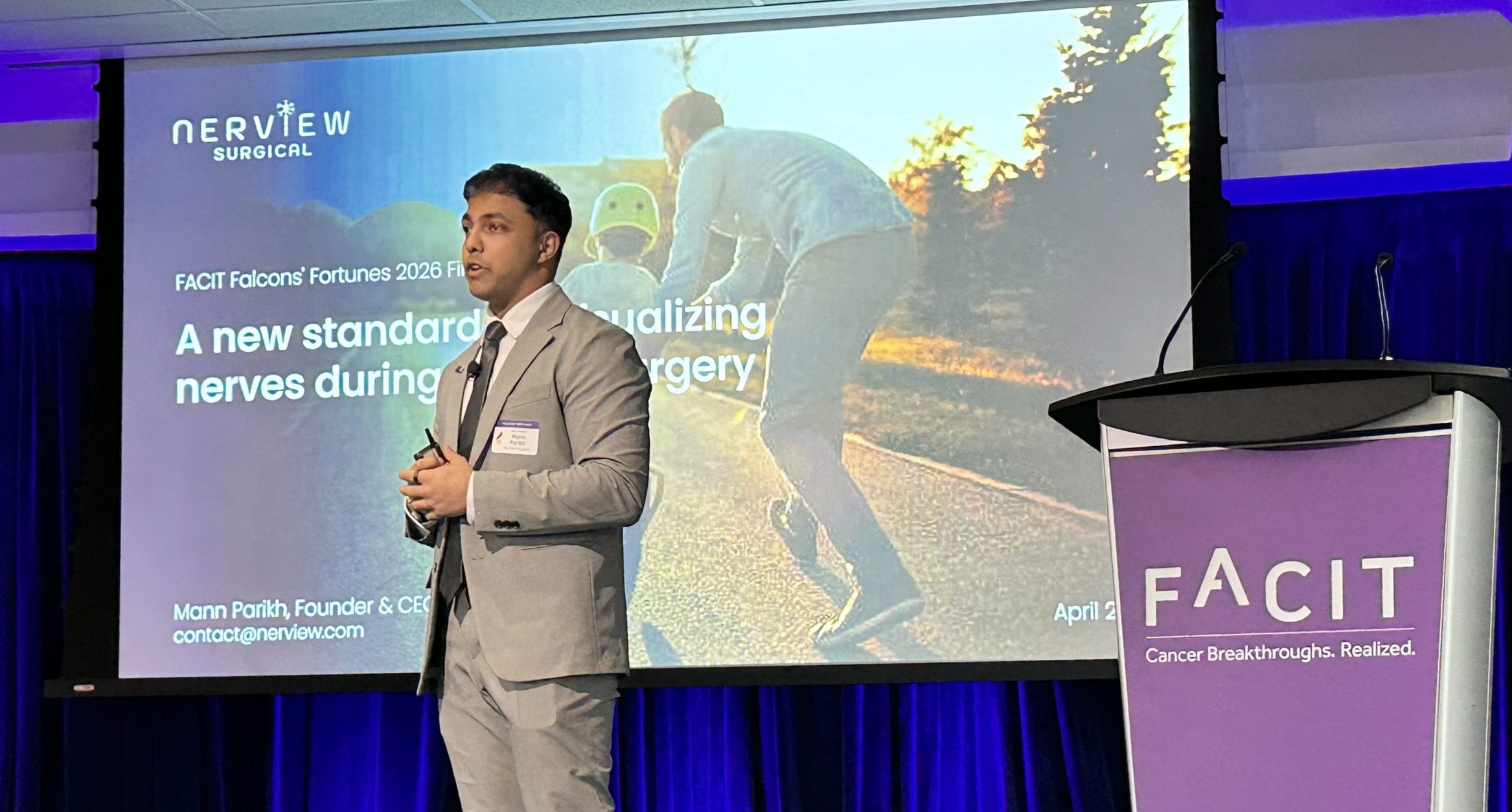
NerView Surgical took home the $100,000 Ernsting Entrepreneurship Award at FACIT’s 2026 Falcons’ Fortunes pitch competition for its real-time nerve visualization technology.
There is a lot for patients to consider as they prepare to have cancer surgery.
Will the surgery successfully remove their tumour? How will they feel afterward? Are there long-term risks?
NerView Surgical founder and CEO Mann Parikh — who recently won top prize at FACIT’s 2026 Falcons’ Fortunes pitch competition — hopes his company’s innovative technology can help reduce surgical risks, ease patients’ minds and spare them from potentially life-changing side effects.
NerView has developed NerveSense™, a handheld imaging tool that allows surgeons to visualize nerves in real time during cancer surgeries and other ‘open’ surgeries involving large incisions. Having a clearer view of nearby nerves — often obscured or distorted by other tissues — could help surgeons avoid accidentally damaging one, which is one of the biggest risks for post-operative complications. The technology could also help improve operating room efficiency.
“We want patients to have peace of mind when they’re going into a surgery,” Parikh says. “We’re trying to bring the risk of nerve damage as close to zero as possible by supporting surgeons with an effective, streamlined tool to visualize nerves.”
Parikh started developing his nerve visualization technology as an undergraduate at McMaster University, where he studied Biomedical Discovery and Commercialization, and then launched NerView Surgical in August 2023.
He was one of six Ontario entrepreneurs selected to pitch their innovations to an expert panel of judges at this year’s Falcons’ Fortunes competition, a sold-out event held in Toronto in April. Now in its 13th year, Falcons’ Fortunes is FACIT’s premier annual event for cancer innovators.
As the winning pitch, Parikh will receive the $100,000 Ernsting Entrepreneurship Award. He will also get access to FACIT’s continuum of funds and support as he continues to advance his innovation.
We asked Parikh about NerView and how FACIT’s support will help him take the next steps.
How did the idea for NerView come about?
During my undergraduate studies, I took a health ventures course that was essentially an accelerated version of the Stanford Biodesign process. It pushed us to get out of the classroom, cold email stakeholders, speak directly with users and understand the problems they faced before trying to build a solution.
I chose to focus on surgeons to understand the challenges they encounter in the operating room. After speaking with surgeons across North America, I started to notice a recurring pattern around the difficulty of identifying nerves during open surgery. Nerves are thin, white structures that can be mistaken for fat or fascia. Without an objective way to distinguish nerve tissue from surrounding tissue, surgeons often have to rely on experience and visual judgment alone. Some described it as operating in the dark.
How did you go about designing a technology to address this need?
I read a paper about using polarized light on a microscopic level to visualize white brain matter during neurosurgery, and I thought, “Why can’t the same technology be applied to visualizing peripheral nerves?” I don’t have a technical background, so I’m largely self-taught. I built the first prototypes by myself in my dorm room. After seeing some early validation on a chicken we bought from the grocery store, I brought on an engineer, and we started building higher fidelity prototypes.
What makes your technology a useful tool for cancer and other surgeries?
Identifying nerves during surgery is critical for preserving function and avoiding complications. NerveSense gives surgeons direct visual identification of nerves in real time, right in the surgical field. That clarity is critical in cancer surgeries, where tumours and treatments can distort normal anatomy and make nerves harder to identify. The system is label-free and contact-free, giving surgeons continuous visual feedback as they dissect. That’s especially valuable in head and neck, thyroid, and other oncologic procedures where preserving nerve function directly affects voice, swallowing, facial movement, and quality of life.
What stage is the technology at right now?
We’ve had some promising early validation results in various pre-clinical models in terms of sensitivity and specificity, and we are currently working on our sixth-generation prototype. We tested our earlier prototypes with mouse models and cadavers, and we’re hoping to do some early human testing soon.
How will this award from FACIT help you achieve your goals?
The opportunity to access this kind of capital is critical as an early-stage medtech start-up. We will most likely put the investment toward important pilot studies and validation work. It will also help us bring in more support on the software side as we continue developing our prototypes and prepare for manufacturing. We are also fortunate to get access to FACIT’s network and commercialization expertise as we continue to grow NerView.
What impact do you hope your work will have for patients?
I’ve been to a lot of conferences over the past few years. At almost every single conference, a patient comes up to me and tells me they had some kind of nerve injury from surgery. That really puts the potential impact into perspective. Our work is ultimately about providing patients with peace of mind, providing surgeons with an effective tool to make informed decisions during surgery, and avoiding unnecessary post-operative side effects.