First-in-Canada genomics platform to support greater access to precision oncology

OICR Genomics is running the country’s first Ultima UG 100 sequencing platform.


By bringing the latest genomic sequencing technology to Ontario, OICR is boosting the province’s capacity for genomics research and helping advance precision oncology for cancer patients.

OICR Genomics has now launched services on the Ultima UG100 sequencing platform, the first of these state-of-the-art machines in Canada.

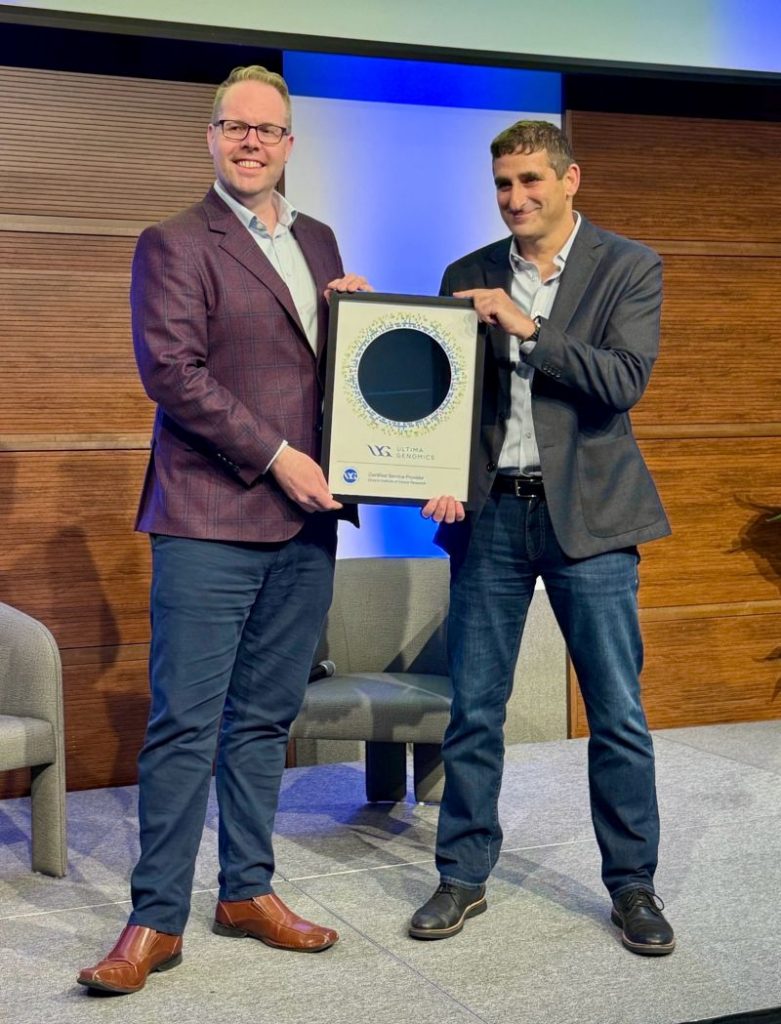
Dr. Trevor Pugh (left) receives a plaque at the MaRS Impact Health conference from Dr. Gilad Almogy, CEO of Ultima Genomics, commemorating OICR Genomics becoming the first Canadian provider of UG100 services.

“Having this cutting-edge technology massively expands the sequencing capacity of our lab, which supports critical OICR projects as well as cancer research across the province,” says Dr. Trevor Pugh, a Molecular Geneticist and Director of OICR Genomics, as well as Senior Scientist at the Princess Margaret Cancer Centre.

Offering high-throughput sequencing at a lower cost, the UG100 can support researchers working with large volumes of samples or who need deeper sequencing. Pugh says this will enable exciting discoveries in diagnosing and treating cancer — including liquid biopsies, where blood samples are tested for tiny fragments of tumour DNA.

Modern genomics platforms can help understand changes to cells that influence the development and spread of cancer. The data from whole genome sequencing (WGS) are critical to precision oncology, an approach to cancer care where tests and treatments are tailored to the unique biology of each patient’s cancer.

“Historically, the cost of whole genome sequencing has limited the breadth and depth of research projects. This meant we could only look at a handful of genes, which limited what can be learned from the data,” Pugh says. “The UG100 sequencer helps solve these challenges and could ultimately help more Ontarians with cancer benefit from precision oncology informed by the entire genome.”

OICR Genomics is the first lab in North American to be accredited by the three major accreditation organizations for whole genome sequencing: CAP, CLIA and Accreditation Canada Diagnostics. To support the next generation of clinical cancer research focused on early cancer diagnoses, they are working to make sequencing services faster and more efficient. This includes pioneering an ‘ultrarapid’ process that reduces the time to deliver results from whole genome and transcriptome sequencing (WGTS) from about 45 days to 14.

“Our program strives to combine established services with new, cutting-edge offerings to meet the needs of scientists, clinicians and cancer patients in Ontario and around the world,” Pugh says.

Critical lung cancer staging streamlined by AI in FACIT Falcons’ Fortunes winning tech

Dr. Waël Hanna of NodeAI Diagnostics took home the $100,000 Ernsting Entrepreneurship Award for his innovative technology to improve lymph node biopsies.


Knowing whether lung cancer has spread to the lymph nodes is essential to treating it, but the procedure to biopsy lymph nodes is challenging — ­even for seasoned thoracic surgeons.

“It’s very finicky, and the technology has not changed in decades,” says Dr. Waël Hanna, Co-Founder of NodeAI, medical researcher and Division Head for Thoracic Surgery at McMaster University.

In the procedure, known as endobronchial ultrasound-guided transbronchial needle aspiration (EBUS-TBNA), the surgeon guides a small endoscope to the centre of a patient’s chest to find their lymph nodes. Then they must thread a tiny needle into the lymph nodes to get a biopsy, guided only by black-and-white ultrasound photos.

Even if the biopsy is successful, lymph node tissue is very difficult to process, and pathologists must have special training to interpret it.

“It’s a multi-step process and each step is challenging,” Hanna says. “It’s hard to optimize because each step relies on the expertise of someone different.”

As a result, Hanna says only half of lung cancer patients end up with reliable, accurate staging that helps to shape their treatment plan.

It’s why Hanna and his colleagues at McMaster started exploring ways to improve the EBUS-TBNA process. They developed an AI-guided solution called ‘NodeAI’ that can help thoracic surgeons assess whether lymph nodes are malignant in real time.

Now Chief Medical Officer of Hamilton-based startup NodeAI Diagnostics, Hanna pitched his technology at this year’s FACIT Falcons’ Fortunes event in March.  The annual pitch competition, now in its 12th year, gives six cancer entrepreneurs the chance to showcase their innovations to a panel of expert judges and forms an important part of FACIT’s Ontario First intellectual property strategy and seed investment programs.

Hanna and NodeAI impressed the judges and took home the $100,000 Ernsting Entrepreneurship Award. FACIT’s pre-seed capital helps ventures like NodeAI advance along the innovation pathway and establish roots in Ontario.

We asked Hanna about his innovative technology, his experience at Falcons’ Fortunes, and how winning the award and support of FACIT will help bring NodeAI into the clinic.


Why did you set out to develop a technology to improve EBUS-TBNA?

Lymph nodes are very, very important in determining how we stage lung cancer. But most surgeons struggle to do accurate staging.My colleagues and I recognized we needed a standardized, reliable computer-based method to assist surgeons with the procedure and augment their judgement.

Tell us about how the NodeAI system works.

The surgeon goes in, finds a lymph node, and takes an image, just like with a normal EBUS-TBNA procedure. At that point, NodeAI reads the image and gives a readout within six seconds. Trained on data from thousands of lymph nodes, NodeAI is able to determine if a lymph node is normal or not with 85 per cent accuracy.

If the lymph node is found to be normal, the surgeon can confidently skip the biopsy. If NodeAI determines the lymph node is abnormal, the surgeon can proceed with a biopsy as normal.

What are the advantages for the surgeon and the patient?

The whole thing happens in real time, using the same equipment as a standard EBUS-TBNA. In total, it adds only about two minutes to the procedure.

Having this data in real time can spare patients from unnecessary biopsies, while improving their chances of accurate staging that can inform their treatment. It also allows the surgeon to focus on the lymph nodes that actually need to be biopsied and takes some of the burden of interpretation off of them during what is a very difficult procedure.

What’s the status of the technology?

We have done successful pilot studies and found no technical issues, and we’re about to start a multi-centre clinical trial at six cancer centres across Canada to gather data on how the system functions in different environments. Things are also moving forward with regulatory approval from Health Canada and the FDA in the United States, though a few steps still remain.

How was your experience pitching at Falcons’ Fortunes?

It was my first pitch competition, and I really enjoyed it. I’ve given a lot of academic talks, but I had to learn the particulars of pitching a startup in this context. I can’t say enough about the pitch training resources offered by FACIT to all finalists. It was extremely valuable for me and the NodeAI team and helped us frame the pitch in a way that highlighted the important elements of the technology and the company.

How will the $100,000 award from Falcons’ Fortunes help NodeAI?

This award will be very helpful as we navigate regulatory processes — particularly with the FDA, which can be very expensive. It will also help us hire a Clinical Trials Manager to manage the multi-centre trial we’re about to launch.

Most importantly though, we can leverage this award from Falcons’ Fortunes to help secure other funding, both through FACIT and other sources. Many seed funders will match the capital from other grants and awards. So winning Falcons’ Fortunes paves the way for NodeAI to acquire even more capital to help us advance our technology and get it helping patients as soon as possible.

Canada-wide network of cancer research partners celebrate significant moment in work to advance precision oncology in the country

Marathon of Hope Cancer Centres Network publishes ‘marker paper’ in esteemed journal Cancer Cell

With its first landmark publication in a high-profile scientific journal, The Marathon of Hope Cancer Centres Network (MOHCCN) is aiming to generate more collaboration both within Canada and around the world. The paper details the creation of the Network, its vision, and how it has united patients, researchers, clinicians, donors, and administrators nationwide to formulate a cohesive, pan-Canadian strategy for advancing precision oncology.

OICR is a MOHCCN partner and numerous OICR researchers and projects are involved in the Network. Many of the Institute’s contributions to MOHCCN flow through the Princess Margaret Cancer Consortium (PM2C), a partnership between OICR, the Princess Margaret Cancer Centre – University Health Network, Queen’s University and the Canadian Cancer Trials Group.

PM2C brings together clinicians, pathologists, data and translational scientists, bioinformaticians, and software developers from across Ontario to build retrospective and prospective patient cohorts and guide data interpretation in the appropriate clinical and molecular context.

“The MOHCCN project greatly advances Canada’s leadership in precision oncology by accelerating the development of diagnostic tests that will allow cancer doctors and patients to choose the therapy that has the greatest chance for success while minimizing the risk of unwanted side effects,” says Dr. Lincoln Stein, Acting Scientific Director and Head, Adaptive Oncology at OICR, and contributor to MOHCCN. “I am proud that OICR plays a key role in the MOHCCN project by providing more than a third of the project’s genome sequencing capacity and providing guidance to the project via its participation in the steering committee and leadership on multiple policy-setting working groups.”

Read MOHCCN’s announcement

‘Ultrarapid’ genomic testing could shift paradigm for cancer treatment

An OICR initiative has reduced the turnaround time for whole genome and transcriptome sequencing in pancreatic cancer studies from 45 to 14 days.


Every day matters in the race against cancer.

Patients need access to the best, most complete information about their cancer so they can receive the best possible treatments. And the earlier they get it, the better their chances.

Speed is especially important in pancreatic cancer, where even a few weeks can dramatically change a patient’s prognosis.

That’s what makes a new ‘ultrarapid’ process for genomic testing pioneered by OICR potentially transformative for cancer care in Ontario and around the world.

Thanks to a collaborative effort involving three OICR programs — OICR Genomics, Tissue Portal and PanCuRx (a translational research program in pancreatic cancer) — the Institute was able to reduce the time it takes to deliver clinically actionable results from whole genome and transcriptome sequencing (WGTS) from about 45 days to 14.

WGTS in cancer is an advanced test that involves reading and analyzing all genetic information in a tumour sample, comparing it to a sample of normal tissue, and analyzing the differences between them. Those genetic differences, often called ‘biomarkers’, can tell doctors how that tumour might grow and respond to different treatments.

It’s a resource-intensive process involving complex machinery, sophisticated analysis, and coordination among a large team, which is why it takes an average of 45 days from when a tissue sample is received at OICR to when a clinical report is issued. Because diseases like pancreatic cancer move quickly, that’s usually too long to influence a patient’s first course of treatment, and that means missed opportunities to treat patients before their cancer spreads.

But getting actionable clinical results from WGTS in just two weeks could change everything.

Dr. Robert Grant

“A two-week clinical turnaround time would be game-changing for patients and groundbreaking in the cancer care community,” says Dr. Robert Grant, a Medical Oncologist at Princess Margaret Cancer Centre (University Health Network) and Clinical Co-Lead of PanCuRx at OICR.

To achieve this turnaround time, OICR Genomics undertook a year-long reorganization of its testing and reporting protocols. Working closely with the PanCuRx and Tissue Portal teams, they optimized existing protocols and developed new methods to process and analyze samples and deliver reports.

This work builds on years of successful optimizations by OICR Genomics, which was the first lab in North America to have a WGTS assay accredited by the three major accreditation organizations: CAP, CLIA and Accreditation Canada Diagnostics.

“This collaborative effort to offer high-level genomic testing and analysis in a fraction of the time is a great example of how we’re working together to strengthen cancer research in Ontario and ultimately improve the lives of cancer patients,” says Dr. Trevor Pugh, a Molecular Geneticist and Director of OICR Genomics, as well as Senior Scientist at the Princess Margaret Cancer Centre.

The ultrarapid pipeline has been trialled in two pilot studies and is currently being integrated into PanCuRx clinical trial design.

PanCuRx already changed the landscape in pancreatic cancer research. The program’s COMPASS clinical trials were among the first to show that genome sequencing could be harnessed to personalize treatment for pancreatic cancer patients.

But only half of patients diagnosed with advanced pancreatic cancer live long enough to receive second-line treatment, so personalized therapies will have the most impact if used to guide initial therapy. This process offers the potential to inform a patients’ first-line treatment, which usually begins within two to three weeks of their initial assessment.

Grant says that having WGTS results could tell doctors which of the standard chemotherapies would work best for a given patient, and also identify other biomarkers that could be targeted with personalized therapies.

“Ultrarapid WGTS could shift the entire paradigm of precision oncology — enabling more timely, personalized treatment strategies and sparking new avenues for targeted therapies in pancreatic cancer and beyond,” Grant says.

While this faster testing protocol is currently only being offered to support PanCuRx trials, OICR Genomics ultimately hopes to offer it for other types of cancer within clinical trials and ultimately within routine clinical care. The programs are also working to further reduce the turnaround time.

Stem cell test predicts leukemia relapse just 30 days after transplant

An OICR-supported discovery could help acute myeloid leukemia (AML) patients get earlier, more personalized treatments to slow down deadly relapses.

A routine test that’s already performed after stem cell transplants can identify patients whose leukemia is likely to return and get them treated sooner, according to new OICR-supported research.

Acute myeloid leukemia (AML) is the most common type of acute leukemia in adults. It’s an aggressive disease, which is most effectively treated by a stem cell transplant.

About 60 per cent of transplant recipients will be cured of AML, but the 40 per cent who aren’t cured will often see cancer return more aggressively.

That sparked a group of Hamilton-based researchers led by Dr. Michael Radford and Dr. Tobias Berg to look for ways to detect signs of AML relapse. Their findings, published in Transplantation and Cellular Therapy, show that a commonly used test measuring the ‘DNA footprint’ of blood cells can give a good indication of a patient’s chances of relapse as early as 30 days after a transplant.

“This is really exciting because the test is a strong predictor of AML relapse very early on, when we can take action to wipe out the disease,” says Berg, Associate Professor of Oncology at McMaster University and the study’s senior author.

AML originates in blood stem and progenitor cells, and while it can sometimes be treated with chemotherapy alone, a stem cell transplant is often a patient’s best chance at a cure. In a successful transplant, the recipient’s blood cells (including its immune cells) are completely replaced by healthy donor cells, some of which can help keep the cancer away.

But new blood cells don’t always replace all the old ones, and they can sometimes co-exist in a patient’s blood, known as ‘mixed chimerism’.

Berg and colleagues looked at DNA test results 30, 60 and 90 days after AML patients received stem cell transplants then followed patients’ outcomes going forward. They found that patients who still had mixed chimerism in those tests were much more likely to relapse.

While chimerism testing is already used in Ontario after stem cell transplants, it’s use and application are varied. The scientists behind this study hope their findings will lead to wider use of chimerism testing to identify AML patients at risk of relapse and trigger further treatment for those who are.

This study on chimerism is part of a larger area of work supported by OICR’s Clinical Translation Pathway. Berg and colleagues also explored tests predictive tests that look for microscopic traces of tumours after treatment — known as minimum residual disease — as well as maintenance strategies to prevent and treat AML relapse in patients identified as high risk. “This work is the result of a strong collaboration, both across Hamilton and across Ontario,” Berg says. “We’re grateful for OICR’s support, which helped bring us all together.”

OICR welcomes Dr. David Cescon as Scientific Director, Clinical Translation

Dr. David Cescon recently joined OICR as Scientific Director, Clinical Translation (CT). In this role, Cescon leads clinical and scientific aspects of CT initiatives, collaborates with supported researchers to design and implement clinical trials, and identifies new opportunities to further OICR’s mission.

Cescon spoke with OICR News about his work as a clinician scientist specializing in breast cancer, how we can leverage Ontario’s strengths to accelerate cancer research and more.

Can you tell us about your work as an oncologist and researcher?

I’m a medical oncologist and clinician scientist at Princess Margaret Cancer Centre. In that role, I have a lab-based research program largely focused on the development of new therapies and biomarkers for breast cancer. The overarching goal of that work is to understand why certain drugs we use in the clinic are effective for some patients but not for others, and why they sometimes stop working. We also investigate new therapies that may help address those unmet needs. We do that by identifying new cancer vulnerabilities or by testing new drugs that are in early phases of drug development. We evaluate those in the context of models that represent the current clinical landscape, which is rapidly shifting.

On the clinical side, I see patients with breast cancer, and I’m engaged in a lot of clinical research in addition to the delivery of care. That includes clinical trials and translational research. We have patients participating in a variety of research programs that are helping to either develop new technologies or new therapies that might improve outcomes for people with breast cancer.

Can you tell us what interested you in the role with OICR?

I’ve interacted with OICR over a number of years and most recently through our Phase II clinical trial that is supported by funding from the OICR Clinical Translation (CT) Program. Through that experience it became clear to me that CT is addressing important and timely challenges in clinical oncology. They are trying to bridge many of the things that I’m interested in. This includes emerging technologies related to diagnostic development, understanding the potential clinical utility of those technologies, matching them to therapies and ultimately delivering individualized care for patients by taking advantage of all those things that can improve outcomes. As a clinician scientist it seemed like a great opportunity to contribute to the overall mission of OICR. Ultimately, improving outcomes for patients in Ontario and globally by advancing the development of those kinds of strategies.

This role is also a way to further engage in collaborative work which has been one of the things that I’ve really enjoyed throughout my career – working in team-based environments locally, internationally, but also across the province of Ontario. The province has a lot of potential that may not be fully tapped. OICR is a unique umbrella organization that may have the ability to maximally leverage the strengths, infrastructure, talent, and engaged population of patients and families that exist in the province.

What do you see as the biggest challenges in advancing research discoveries into the clinic?

Keeping pace with the rapid emergence of scientific knowledge and technology platforms that are changing practice is a big challenge. To ensure that advancements can reach patients in Ontario, we must generate the appropriate data to demonstrate that they have clinical utility, can be feasibly delivered, and are cost-effective. All of these are necessary to be able to deliver healthcare in a publicly funded environment. I think that OICR can have significant impact in accelerating this progress through the work supported by CT.

Does Ontario have any unique advantages when it comes to moving discoveries to the clinic?

Ontario has a large and diverse population, and cancer care delivery is harmonized across the province. Our single payer system means that there is generally uniform delivery of care and relatively consistent treatment paths. In some jurisdictions, patients may be treated differently because of what insurance companies are willing to cover. The Ontario advantage is that we can capture the breadth and diversity of our 16 million plus population, engaged clinicians and researchers, and tap into our provincial infrastructures to investigate clinical and translational research questions.

How do you view the role of patient partners in research?

A huge amount of the work that I’m engaged in as a clinician scientist really depends on the active participation of patients. This includes the work that we do in the lab because patients donate samples, it includes all the translational work that we do in the clinic and of course it includes clinical trials which can’t be done without the contributions of patients and their families who volunteer to participate. My efforts in research are ultimately motivated by my interactions with patients and attempting to understand their needs such that we can improve the outcomes and the patient experience. It’s critical for us to make sure the questions we are asking are relevant to patients and that we make participation in research as accessible as possible. We are fortunate at OICR to have the very dedicated Patient and Family Advisory Council, and I am looking forward to working with them to integrate their expertise into the work of CT.

How has your experience at OICR been so far?

I have felt very welcomed by the CT team and by everyone at the wider Institute. Obviously, there’s a lot to learn, but I’m looking forward to engaging with colleagues from across all the different research areas that OICR is active in. Whether it is basic research or more applied, all efforts eventually converge on CT if they are going to impact clinical care. I’m looking forward to hearing their insights and discussing ways we can work together to bring research discoveries to patients.

Let’s talk about clinical trials: How patients are protected

The second installment in our series looks at the structures in place to ensure clinical trials are safe for participants.

The first part of our Let’s talk about clinical trials series explored why cancer clinical trials are important to research, and how cancer patients can benefit from participating.

In this next installment, we’re talking about the safety and wellbeing of the people who participate in clinical trials.

Natascha Kozlowski

We asked Natascha Kozlowski, Executive Director of the Ontario Cancer Research Ethics Board (OCREB), about how clinical trials, and the systems around them, protect the health and safety of trial participants.

What potential advantages are there for patients interested in participating in a clinical trial?

Clinical trials provide options for patients, and the potential to access the latest therapies years before they would otherwise be available. There are no placebos in cancer clinical trials. All participants receive, at minimum, the standard of care they would receive as part of their regular cancer treatment. And by participating, they are helping develop even better methods to prevent, diagnose and treat cancer that will benefit future generations.

What systems are in place to ensure that clinical trial participants are protected?

Clinical trials undergo a lot of scrutiny before being launched. For one, trial proposals are often peer reviewed to make sure their design and procedures are safe and scientifically rigorous. They also undergo a detailed review by regulatory bodies like Health Canada to ensure there is solid evidence behind the device or medication being tested. And, of course, clinical trials must be reviewed by a research ethics board to ensure any potential risks or burdens for participants are minimized. So, it’s a three-pronged approach, and it’s quite robust.

Tell us more about how research ethics boards ensure participant safety.

Research ethics boards are independent committees of experts that thoroughly review clinical trials with the rights and welfare of participants in mind.

They evaluate whether the research team has the credentials to safely perform a trial, whether there is any conflict of interest that could compromise patient safety, and whether any part of the trial design could pose undue risk for participants.

Risk mitigation is extremely important. The potential benefits of a trial must outweigh any potential risks for participants, and any risks must be clearly outlined in the consent process so that participants can make informed decisions.

Clinical trials can’t move forward unless they are approved by a research ethics board, and there are several conditions that must be met for that to happen.

What advantages are there in having a cancer-specific research ethics board like OCREB?

As a specialized research ethics board, OCREB only reviews cancer research studies. Our committee is comprised of world-class oncologists, statisticians, pathologists, pharmacists, research staff, scientists, ethicists, legal and privacy experts, cancer patients and community members who understand the complexities of cancer research.

That allows OCREB to streamline the review process, with fewer questions for the research team, and usually a faster turnaround time so that promising, safe clinical trials can proceed more quickly.

Why should cancer patients ask their doctor about clinical trials?

Cancer treatment is a very personal decision. Asking about clinical trials can add interesting new options to that decision — for that patient and for others in the future.

While clinical trials may not be an option for every cancer patient, asking their doctor about trials allows patients to take a more active role in their health. It could also be hugely beneficial for others affected by cancer.

Right now, only a fraction of adult cancer patients participate in clinical trials. If more people participate, research and care will advance at a faster rate, and we can take even bigger steps toward solving cancer.

Ask a Cancer Researcher: Why do some mutations cause cancer, yet others don’t?

In this Ask a Cancer Researcher video, Dr. Philip Awadalla, Director, Computational Biology at OICR, explains the role of genetic mutations in the formation of cancer.

A promising new way to stop proteins that drive cancer

A study led by OICR drug discovery researchers could pave the way for new treatment options for blood cancers.


OICR researchers have discovered a new way to target proteins that drive leukemia and other cancers that could help generate new, more efficient drugs to treat them.

In a study published in Nature Communications, OICR Drug Discovery scientists created small molecules called PROTACs that trigger a cell’s natural waste-disposal processes in order to eliminate a protein called WDR5 — a well-known driver of multiple cancers.

The work builds on OICR’s rich portfolio of drug discovery research into WDR5, including creating a first-in-class WDR5 inhibitor that attracted a major industry investment in 2019.

This new study leverages a different pathway to degrade WDR5 that involves an understudied protein called DCAF1 which functions as a ‘receptor’ for proteins that a cell is ready to target for disposal. The PROTACs researchers created for the study bind to WDR5 on one side and DCAF1 on the other, effectively telling a cell to destroy WDR5.

“We have reported an efficient way to eliminate WDR5, which is a key target for the development of cancer therapeutics,” says Dr. Masoud Vedadi, OICR Senior Scientific Advisor and the senior author of the Nature Communications paper.

Before this study, very few researchers had used DCAF1 to target cancer-linked proteins. But Vedadi says his team’s findings are promising for few key reasons.

For one, DCAF1 is important to many different cellular processes. Therefore, it’s unlikely to be mutated or downregulated, which can happen to other receptor proteins. That means therapeutics that use DCAF1 to knock out a target protein would be effective for longer than drugs that exploit other pathways.

“DCAF1 is a highly attractive, sustainable system for getting rid of proteins because the cell needs it to survive,” Vedadi says.

The study was also the first to publish the crystal structures of DCAF1, PROTACs and WDR5 bound together — known as ‘ternary complexes’ —  which showed that DCAF1 proteins have dynamic, flexible ‘loops’ that latch onto a PROTAC and the target protein and ensure they stay securely bound.

Vedadi says that makes DCAF1 even more effective at knocking out unwanted proteins and could have implications for other drug targets beyond WDR5.

While the study was the result of a large and fruitful collaboration involving OICR, the University of Toronto and Princess Margaret Cancer Centre, much of the science was done in-house at OICR. Vedadi says that’s a testament to the diverse expertise on the Institute’s Drug Discovery team.

“We have a unique set of expertise in house at OICR that makes the flow of science highly efficient and enables us to make game-changing discoveries,” he says.

Ask a Cancer Researcher: What is a biomarker?

Dr. Jane Bayani, Co-Director of OICR’s Diagnostic Development Program, explains biomarkers and how they can be used in the diagnosis and treatment of cancer.