Unraveling the story behind the cancers we can’t explain
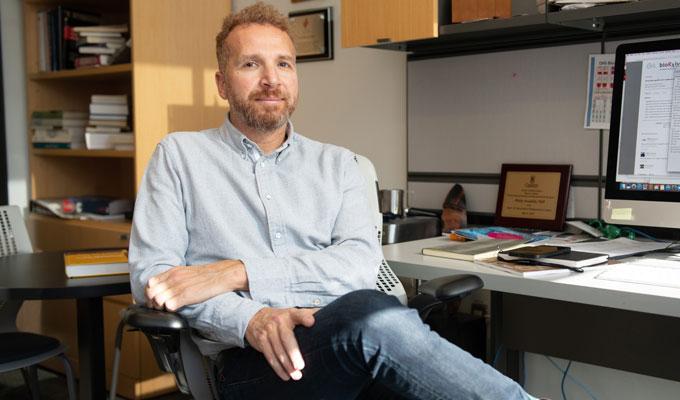
Dr. Philip Awadalla
The Pan-Cancer Analysis of Whole Genomes Project has shown that despite cancer’s complexities, researchers are close to cataloguing all of the biological mechanisms that lead to the disease.
We sat down with Dr. Philip Awadalla, OICR
investigator and National Scientific Director of the Canadian Partnership for
Tomorrow Project, and Dr. Fabien Lamaze, Postdoctoral Fellow in the Awadalla
Lab, to discuss.
What
can RNA show us about cancer?
PA: Cancer
is thought to be a disease of the genome, where changes – or mutations – in an
individual’s DNA accumulate and eventually lead to the development of the
disease. Often, we can identify the mutations that drive this development,
figure out the related mechanisms and design new therapies with that
information, but sometimes no such ‘driver mutation’ exists.
We believe that RNA can help us unravel the
story behind these cancers that we can’t yet explain.
What
did the study find?
Dr. Fabien Lamaze
FL: In
this study, we took a deep dive into the transcriptome – the RNA – of nearly
two thousand tumour samples donated by patients from around the world,
representing 27 different types of tumours. The group found more than 1.5
million different RNA alterations and related mechanisms in these samples,
exposing the true complexity of the disease.
Interestingly, the study found key RNA
alterations in patient samples with no DNA driver mutation. This suggests that
some of the cellular changes that lead to cancer may manifest in RNA rather
than DNA mutations.
What
does this mean for the future of cancer research?
PA: We see that cancer is complex and we need even more data to fully
understand it, but we’ve also shown that we can make this happen by working
together.
FL: The Pan-Cancer Analysis of Whole Genomes Project was the product
of an enormous international study that was only made possible by the
dedication and true collaboration between thousands of researchers from around
the world. For this study, in particular, I’d like to recognize the scientific
leadership of Dr. Angela Brooks and collaborators from the University of
California, Santa Cruz.
PA: As more patient samples are collected and sequenced, we look
forward to using the software tools and infrastructure from the Pan-Cancer
Project to gain further insights into cancer biology.
How
can this help cancer patients?
FL: Understanding
the changes that lead to cancer can help us design better tests and new
treatments for future cancer patients. This study, for example, discovered six
interesting gene fusions involved with cancer, where two genes come together,
join in an abnormal way and wreak havoc. In the future, we could potentially
develop new drugs that target the downstream products of these fusions and stop
them from causing further damage in the cell.
PA: With the knowledge we’ve gained in this study, we look forward to furthering diagnostic and therapeutic research and development so we can ultimately treat patients more successfully. Work is already underway to make this happen.
Discovering cancer’s vulnerabilities: The whole may be greater than the sum of its parts
OICR and Pan-Cancer Project researchers map key cancer pathways, signposting new directions for its diagnosis and treatment
What works in a lab
experiment doesn’t always work in the complex human body. But as technology
advances, researchers are gaining the ability to study different features of a
cancer cell and the interactions, mechanisms and pathways between them. As more
data become available, however, it is becoming increasingly
difficult to find the most important molecular pathways that, when blocked, can
stop the progression of the disease.
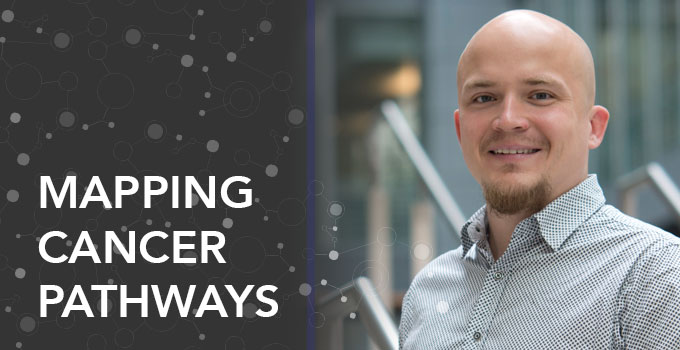
Dr. Jüri Reimand’s lab specializes in this area.
“Researchers often collect molecular data on one
aspect of a cancer cell at a time, like its DNA, RNA or proteins,” says
Reimand, who is an OICR Investigator. “If we can weave these complex molecular
datasets together into a bigger picture, we can gain a more thorough understanding
of cancer and potentially find new ways to tackle the driving mechanisms behind
the disease.”
Decoding
the donors’ data
Thanks to more than 2,500 patient donors from around the world, the Pan-Cancer Project presented one of the largest cancer datasets to date. The Project made hundreds of terabytes of data available to the global cancer research community in a coordinated effort to advance our understanding of the disease.
To help interpret these data, the Reimand Lab developed ActivePathways – a statistical method that can discover significant pathways across multiple molecular omics datasets. These methods, published today in Nature Communications, allow researchers to characterize the cell at a systems-level, decipher how the components interact and tease out the most important pathways.
“We designed a simplified approach to tackle
one of the largest cancer genomics datasets to date,” says Reimand. “With these
methods we can now chart important interactions that we wouldn’t have
recognized by looking at one component or dataset alone.”
The
power of the ensemble
The Reimand Lab teamed up with researchers in Belgium, Norway, Spain, Switzerland and across the U.S. who were also interested in analyzing the important pathways within the Pan-Cancer Project dataset. They combined their methods and expertise and identified nearly 200 important driver pathways across 38 different cancer types.
Their findings showed that cancer cells often
have related or coordinated mutations in the coding regions and the non-coding
regions of the genome.
Now, we have better methods and stronger evidence to move forward as we investigate how to block these pathways, and further, block the progression of the disease. – Dr. Jüri Reimand
“Together, we came to a consensus list of
frequently mutated molecular pathways, processes and target genes,” says
Reimand. “Now, we have better methods and stronger evidence to move forward as
we investigate how to block these pathways, and further, block the progression
of the disease.”
All tools, methods and data related to the
collaboration are freely available for the research community to use for future
research.
“We’re proud of this progress,” says Reimand.
“We look forward to the future research that will build on these findings
towards better cancer diagnostic tests and treatment options.”
New open-source software judges accuracy of algorithms that predict tumour evolution
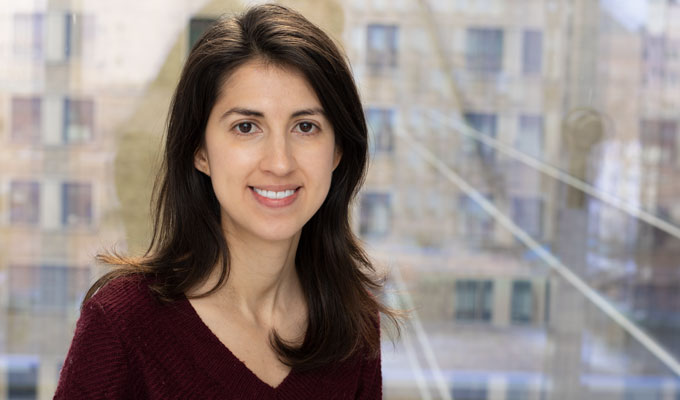
Adriana Salcedo
OICR-led international research group
develops new open-source software to determine the accuracy of computational
methods that can map the genetic history of tumour cells.
A cancer patient’s tumour is often made up of many cells
with different genetic traits that can evolve over time. Interest in tumour
evolution has grown over the last decade, giving rise to several new
computational tools and algorithms that can characterize genetic diversity
within a tumour, and infer patterns in how tumours evolve. However, to date there
has been no standard way to compare these tools and determine which are most
accurate at deciphering these data.
The genetic differences between tumour cells can tell us a lot about a patient’s disease and how it evolves over time – Adriana Salcedo
In a study recently published in Nature
Biotechnology, an OICR-led international
research group released new open-source software that can be used to judge the
accuracy of these novel algorithms.
Bridging the GAPP: Bringing new diagnostic tests to patients
Dr. Jane Bayani discusses how OICR is partnering with Thermo Fisher Scientific to bring new diagnostic tests from the lab into the clinic and how Genome Canada’s Genomic Applications Partnership Program (GAPP) is making that possible.
Solving Big Data problems
Dusan Andric talks about Overture and how its interchangeable tools can help scientists to “worry less, science more” https://www.overture.bio/
FACIT launches assessment of venture philanthropy models to scale Canadian commercialization of cancer research
TORONTO, ON (November 6, 2019) – FACIT, a commercialization venture venture firm, reported on the expansion of its Executive-in-Residence program and new strategic initiatives. Ontario is home to world-leading cancer research connected through the collaboration model established by the Ontario Institute for Cancer Research (OICR), FACIT’s strategic partner. Growing market signals suggest Canadian philanthropy, oncologists and patients want more discoveries translated into therapies and technologies that directly impact cancer care, while also supporting Canadian entrepreneurialism. Commercialization of innovations is aligned with OICR’s translational mission and a strategic imperative for the province’s university and research hospital partners.
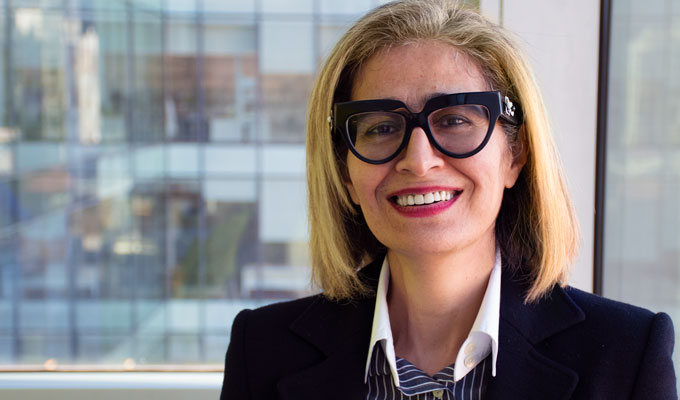
Dr. Rima Al-awar promoted to Head of Therapeutic Innovation and Drug Discovery at OICR
Al-awar joins OICR’s executive team with plans to expand drug discovery and development initiatives across Ontario
Dr. Rima
Al-awar has joined OICR’s executive team as Head, Therapeutic Innovation and
Drug Discovery. In this role, she will lead one of OICR’s
three key priority areas, Therapeutic Innovation, which focuses on validating
novel cancer drug targets and advancing therapeutic candidates through
pre-clinical development. She will
continue leading OICR’s Drug Discovery Program and will build upon that team’s
exceptional work in her new position.
Here she discusses her new role and her plans
to grow OICR’s Therapeutic Innovation platform.
What
does this promotion mean for you and your team?
Since joining OICR, I have spent several years
building an experienced and talented team that I’m very proud of. We have
developed great assets and established fruitful partnerships with collaborators
and industry partners. We have a very rich and promising portfolio of potential
new cancer therapeutics.
I believe we are in a great position to expand
and capitalize on our successes. My new position will allow me to take a
strategic role in therapeutic innovation at OICR so that we can enable future
successes both here, in Toronto, and across the province. I need to think of
creative and strategic funding models, how best to strengthen the platform’s structure
and establish additional synergistic partnerships in the community. In the long
run, this means advancing more projects into development.
How
will this new role allow you to do that?
I’ll have a seat at the table in strategic
conversations with our executive team. I’ll bring a unique perspective with my
expertise in drug discovery and development, and I look forward to representing
Therapeutic Innovation, an important part of OICR.
In this role I will also help ensure that
resources are allocated to the most promising projects. I’m a big proponent of focusing
on select projects and doing them well and in a timely and competitive fashion
as opposed to stretching our resources across too many projects, which often
ends up slowing progress. In this position, I believe I can do that more
effectively.
My goal is to continue to strengthen our current collaborations and forge new ones.
How does
this new appointment differ from your previous position as Director of Drug
Discovery?
I will still be leading the Drug Discovery
team, but I’ll be relying on leaders within the team to take on some of my
previous day-to-day responsibilities, and in turn, they will delegate some of
their current responsibilities. I see this role as an opportunity to strengthen
the Drug Discovery team and encourage the pace of career development within the
team.
Within the scope of my new role, we are going
to have to think creatively about progressing additional projects forward faster,
which will mean harnessing new technologies and recruiting new expertise in
different scientific disciplines.
When it comes to collaborations, I expect that
my role will be just as collaborative as it was before. My goal is to continue
to strengthen our current collaborations and forge new ones. We can’t bring new therapeutics to patients
on our own.
What can
we expect to see over the next year?
I want to explore the idea of expanding our
breadth of collaborations to include biologics, immunotherapies, and novel drug
delivery methods, technologies and models that impact drug discovery. I will be
travelling to different research institutes across the province and outside of
Ontario to look for more opportunities. The goal of this effort would be to
identify and build on strengths in the community. We’re looking to enable and
facilitate new, promising projects in areas of unmet needs. Expanding our
network across Ontario is very important. We have built a strong foundation, we
have deep expertise, a rich portfolio and now we are going to take it to the
next level. I look forward to encouraging more synergy across our organization
and Ontario.
FACIT and University of Toronto launch precision medicine company: Cellular Analytics
Next generation liquid biopsy platform to revolutionize companion diagnostics
TORONTO, ON (October 30, 2019) – FACIT, a commercialization venture group, together with the University of Toronto (“U of T”), announced the creation of Ontario-based Cellular Analytics (the “Company”). Cellular Analytics is founded upon a proprietary microfluidic platform that enables molecular characterization of cancer at the level of single circulating tumour cells. The technology quantitatively detects sensitivity to immune-oncology agents ‘on-chip’ at both significantly lower sample volumes and at a fraction of the cost. Seed capital from FACIT’s Compass Rose Oncology Fund will be used to develop the non-invasive, commercial prototype of the Company’s lead product. This critical capital also allows Cellular Analytics to maintain its momentum and continue strategic discussions with potential partners and investors to attract follow-on financing.
The platform, with an initial application in lung cancer, was discovered at the U of T lab of Dr. Shana Kelley. The professor and serial entrepreneur will act as the Chief Scientific Officer of Cellular Analytics. “Dr. Kelley’s technology is rapid, exquisitely accurate and inexpensive, which positions the Company well for clinical application across a range of cancers and competing in the diagnostics market,” said Dr. David O’Neill, President, FACIT. “Partnering with the University of Toronto on exciting new biotechnology companies like Cellular Analytics is aligned with FACIT and OICR’s joint strategy to support entrepreneurship and translate the benefits of research to patients and the Ontario economy.”
FACIT’s Prospects Oncology Fund invests in Ontario-developed medical device and novel therapeutic platform technologies
Niche early-stage investment program seeds Ontario’s developing pipeline of oncology assets
TORONTO, ON (September 26, 2019) – Three promising Ontario-based oncology innovations are recipients of seed capital through the latest round of FACIT’s Prospects Oncology Fund. Medical device start-up Xpan Inc., Dr. Igor Stagljar of the University of Toronto, and the Drug Discovery Program at the Ontario Institute for Cancer Research (OICR) were selected to receive seed funding among a top-tier pool of applicants.
Xpan Inc., whose CEO Zaid Atto also won FACIT’s Falcons’ Fortunes pitch competition earlier this year, is developing expandable surgical access ports that aim to increase safety and efficiency of minimally invasive surgeries. Dr. Stagljar is developing a unique and disruptive system for detecting protein-protein interactions in real time for drug discovery applications, while OICR’s Drug Discovery Program, led by Dr. Rima Al-awar, will receive funds towards the development of a platform targeting multiple members of the WD40 repeat domain (WDR) family with small molecules. The lattermost project builds on OICR and FACIT’s recent success in executing a $1B USD strategic transaction with Celgene for a related WDR5 asset.
This website uses cookies in order to optimize the user’s experience. To learn more about how we use cookies on this website, please review our Website Privacy Statement. Your browser settings may allow you to turn off cookies. By continuing to use our website site without changing your browser settings, you consent to our use of cookies in accordance with Website Privacy Statement