
Learn about how the Ontario Tumour Bank evaluates the quality of tumour samples stored at ultra-low temperatures over the last decade.
Learn about the Ontario Tumour Bank
Monique Albert, Director of the Ontario Tumour Bank (OTB) explains how OTB provides cancer researchers with the high-quality biospecimens and data they need for their studies.
Entrepreneurs from Ontario’s Nanology Labs and Xpan Inc. receive FACIT investment for early-stage cancer innovations
Latest recipients slated to accelerate Ontario’s commercialization momentum are a 2018 finalist and 2019’s winner of FACIT’s Falcons’ Fortunes pitch competition
TORONTO, ON (April 8, 2019) – FACIT, an Ontario First business accelerator and investor for oncology innovations, is pleased to announce recent successes in its mission to help bridge the capital gap often experienced by early-stage entrepreneurs. The newest recipient of FACIT’s Prospects Oncology Fund is Nanology Labs, a start-up based out of the University of Toronto.
Nanology has developed an innovative low toxicity MRI contrast agent that circumvents the limitations of other MRI contrast agents currently available. This exciting nanoparticulate system leverages manganese to illuminate early stage tumours, including those in the brain, in a manner that allows clinicians to make better treatment decisions. Concurrently, it produces oxygen molecules in the tumour which enhances therapeutic efficacy of irradiation. “This seed funding is critical in enabling our technology to reach its next inflection point, moving our system closer to the clinic and positioning our company for further investment,” said Dr. Mohammad Ali Amini, CEO and Co-Founder of Nanology. “We were fortunate to have been chosen as a finalist in FACIT’s 2018 pitch competition, which helped to strengthen our subsequent application to the Prospects Fund.”
(more…)Meet the researchers – Rosita Bajari
Find out what a Technical Business Analyst does and why this job is so important in helping researchers and software engineers work together.
New potential treatment for leukemia discovered by OICR scientists draws major industry investment
TORONTO (January 29, 2019) – A first-of-its-kind therapy for leukemia discovered by researchers in the Ontario Institute for Cancer Research’s (OICR) Drug Discovery Program, and under preclinical development, has attracted investment from Celgene Corporation that could exceed US$1 billion – which would make it the largest transaction to date for a preclinical asset discovered in Canada.
This investment will allow for clinical trials based in Ontario, and will further research and development of the drug and other cancer research innovations developed in the province. The commercialization of this technology was conducted by OICR’s strategic partner FACIT and demonstrates the realization of the two partners’ long-term vision of creating a sustainable pathway for therapeutic innovation in Ontario.
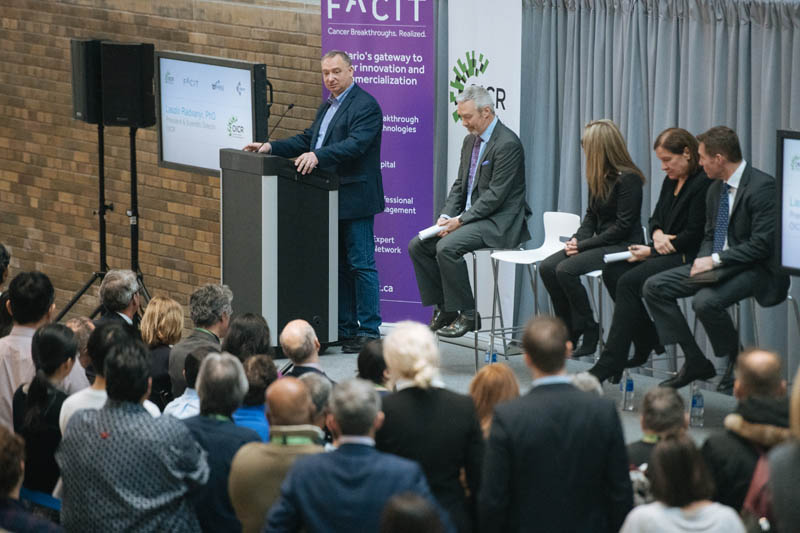
“The progress of this pre-clinical drug towards the clinic is an example of how OICR, working with its partners, is accelerating cancer research in Ontario and increasing investment so that new innovations can help patients as soon as possible,” says Dr. Laszlo Radvanyi, President and Scientific Director of OICR. “Today’s announcement shows how OICR and FACIT’s unique model for research and commercialization can generate long-term impact for the province of Ontario.”
The project is built on the observation that a protein known as MLL-1 plays an important role in promoting the development of leukemia. It does this through binding with a partner protein called WDR5. This new therapy works by disrupting the MLL-1/WDR5 protein-protein interaction, therefore inhibiting the cancer-promoting activity of the MLL-1 protein.
The possibility of targeting WDR5 to disrupt the cancer-driving activity of MLL-1 was first suggested by one of OICR’s partners, the Structural Genomics Consortium (SGC) at the University of Toronto, where researchers saw its potential and proposed a collaboration with OICR’s Drug Discovery (DD) program. OICR DD and SGC researchers worked together to develop an active and selective WDR5 “chemical probe” that could be used to test the anti-leukemia hypothesis. After OICR and SGC scientists demonstrated this probe could disrupt the interaction of WDR5 and MLL-1 in cells, they shared the compound with academic investigators in Ontario and around the world, who showed the probe could stop the growth of leukemia and other cancer cells.
Once the probe was in the public domain, the OICR DD group seized the opportunity to leverage its expertise to improve the drug-like properties and potency of the probe, while creating novel intellectual property, in order to fully realize its therapeutic and commercial potential. This subsequent development of the pre-clinical drug by OICR DD was made possible by their extensive experience in the pharmaceutical industry and academia, a unique model that has helped to develop assets that are solid candidates for investment and further development by industry partners. OICR DD is one of the only industry-academic hybrid drug discovery teams in Ontario.
(more…)Researchers discover common markers of tumour hypoxia across 19 cancer types
Landmark pan-cancer study analyzes mutation signatures of low oxygen in more than 8,000 tumours
TORONTO (January 14, 2019) – Unlike healthy tissues, tumours thrive in low-oxygen environments, often acquiring the ability to resist treatment and spread to other sites in the body. Despite being a well-known cause of therapy resistance and metastasis, the impact of low oxygen, known as hypoxia, on tumour cells is poorly understood. As reported today in Nature Genetics, researchers have discovered molecular hallmarks of hypoxia in the first-ever pan-cancer analysis of low oxygen in human tumours, with a special focus on prostate cancer.
The study investigated more than 8,000 human tumours across 19 different cancer types, including prostate tumours from the Canadian Prostate Cancer Genome Network (CPC-GENE). The authors discovered common markers of hypoxia that could help predict cancer aggressiveness and inform treatment decisions.
(more…)Meet the researchers – Nicholas Khuu
What does a ball of elastic bands have to do with cancer research? Watch Nick Khuu explain. Nick is a Quality Assurance Coordinator in OICR’s genomics lab working on sequencing for OICR’s COMPASS clinical trial. He uses an #elasticbandball to explain #sequencingcoverage and how this sequencing technique can provide extra information to health care providers when treating patients with pancreatic cancer.
Meet the researchers: Lawrence Heisler
Lawrence Heisler, Project Manager in the Genome Sequence Informatics team at OICR, talks about how new technologies are making genetic sequencing faster and cheaper. But turning data into discoveries requires the right behind-the-scenes support. That’s where Heisler’s team comes in.
Meet the researchers: Kelly McDonald
Kelly McDonald talks about her work at the Ontario Heath Study and how the data provided by participants is now helping researchers in Canada and around the world.