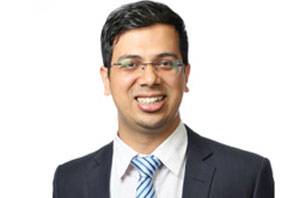

OICR Investigator Dr. Bishal Gyawali and his Common Sense Oncology movement want to make cancer research and care more patient-centric
What matters most in cancer research?
For OICR Investigator Dr. Bishal Gyawali, the answer is simple: whatever matters most to patients.
“As researchers, we need to be asking if what we are investigating is what patients care most about,” says Gyawali, a Medical Oncologist and Professor at Queen’s University. “If it isn’t, we may need to rethink our priorities.”
In his research, Gyawali looks at cancer clinical trials themselves — the questions they ask, what they measure, and how they are reported. He also researches cancer policy, health economics and health equity. Though his studies are diverse, his overarching focus is ensuring patients and their needs are prioritized.
That’s why he co-founded Common Sense Oncology, a group of cancer researchers, clinicians, policymakers and patients advocating for a more patient-centric approach to cancer research and care.
The group recently held its fourth annual meeting this spring, and we took the chance to ask Gyawali about Common Sense Oncology and the latest from his own research.
What is Common Sense Oncology and how did it come about?
Common Sense Oncology is a movement of like-minded people who have noticed that cancer research and care don’t always address what matters most to patients. It started with myself and Dr. Christopher Booth at Queen’s University in Kingston. Our first meeting was in 2023 and included about 25 people from all over the world. Three years later, we have grown into an internationally recognized voice with high-profile publications and collaborations around the world.
How are clinical trials losing sight of what matters to patients?
Cancer patients want to live longer and live better, so their priorities are most often survival and quality of life. But a lot of clinical trials will focus on other outcomes when they evaluate a new cancer treatment. Trials will be considered a huge success if that treatment shrinks a tumour by a small percentage, without considering the impact on survival or the side effects patients may experience. Results also focus mostly on whether it was statistically significant rather than by how much patients’ lives improved. That’s not very patient-centric.
How do you describe the focus of your research?
My work involves a lot of different threads, but they are all in service of ensuring equitable access to cancer treatments that actually help patient. There’s an education component — I mentor young researchers and recently published a paper on how to critically appraise clinical trial reports that people have told me is helpful in understanding what trial results mean for cancer patients. Studying clinical trials themselves is another big part of my work, highlighting strengths and limitations in certain trials with an eye on patient priorities. I’m also focused on issues around access to cancer care like financial toxicity, for example, which we recently found is associated with poorer survival and quality of life. Most recently, I published in Nature Medicine about how toxicity reporting in cancer clinical trials can be misleading, and suggested ways to make it more balanced and objective.
What is one major shift you would like to see in cancer research?
I would like to see more trials focused on de-escalation, to explore whether patients could see the same results with lower doses of medications than the current standard of care. I recently published a paper on a different approach to de-escalation trials I believe could help more of these studies get traction. There is a lot of evidence that we are over-treating patients and it’s causing unnecessary side effects. If we can show that, for example, half the dose of a very expensive drug gets the same outcome, that could mean a better experience for patients and major downstream savings for the health system.
What can researchers to do make sure their studies are more patient-centric?
If the study is a phase 3 randomized control trial, they can follow the checklist my Common Sense Oncology colleagues and I published in the Lancet Oncology. It has guidance how to design trials, measure outcomes and report results in ways that are meaningful to patients.
More generally, researchers can start by asking themselves: what am I actually measuring, what does it actually mean for patients, and is it something that is ultimately important for their lives? Or better yet, ask patients those questions.