InterConnections
Where Fate Changes Colour
Receive the latest news, event invites, funding opportunities and more from the Ontario Institute for Cancer Research.

Where Fate Changes Colour
by Mohammad Al Ayach
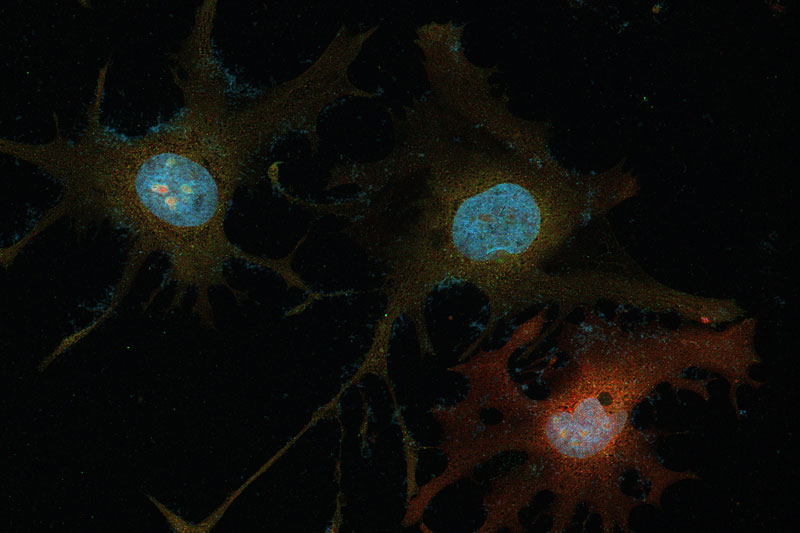
Glioblastoma is an aggressive brain cancer whose cells can change identity. This image shows patient-derived tumor cells nudged to mature. We stained S100B (red), a protein found in astrocyte-like cells, and NEUROD1 (green), a switch that promotes neuronal fate. In the center, two neighboring cells glow yellow where red and green overlap, evidence of a mixed, in-between state, while, to the right, a third cell is mostly red, suggesting an astrocytic bias as NEUROD1 fades. Such plasticity helps tumors resist therapy. Our work asks how the receptor OSMR inhibits differentiation, and tests ways to push more cells into a stable, non-stem fate that could make tumors less aggressive and more responsive to treatment.
Artist statement
Caught mid-shift, colour becomes language. Yellow says “both,” red says “not yet.” Even under glass, choice is alive.
Tools and techniques used
Z-stack acquired at 100× with structured-illumination optical sectioning (Zeiss ApoTome) widefield. Immunofluorescence for S100B (594, red), NEUROD1 (488, green), and DAPI (blue). ApoTome deconvolution and extended depth of focus applied, unsharp mask for clarity.
Credits
Mohammad Al Ayach, PhD Candidate
Cellular & Molecular Medicine
Jahani-Asl Lab
University of Ottawa;

InterConnections is supported by Illumina