Landmark study links tumour evolution to prostate cancer severity

Largest-ever study of its kind uses a tumour’s past to accurately predict its future

Toronto (April 19, 2018) – Findings from Canadian Prostate Cancer Genome Network (CPC-GENE) researchers and their collaborators, published today in Cell, show that the aggressiveness of an individual prostate cancer can be accurately assessed by looking at how that tumour has evolved. This information can be used to determine what type and how much treatment should be given to each patient, or if any is needed at all.

The researchers analyzed the whole genome sequences of 293 localized prostate cancer tumours, linked to clinical outcome data. These were then further analyzed using machine learning, a type of statistical technique, to infer the evolutionary past of a tumour and to estimate its trajectory. They found that those tumours that had evolved to have multiple types of cancer cells, or subclones, were the most aggressive. Fifty-nine per cent of tumours in the study had this genetic diversity, with 61 per cent of those leading to relapse following standard therapy.

(more…)

Restorative Breast Cancer Solution Start-Up Wins the 2018 FACIT Pitch Competition

Biotechnology competition modeled after popular TV program Dragons’ Den

TORONTO, ON (April 12, 2018) – A panel of investor-judges has selected Ontario-based oncology researcher Soror Sharifpoor of Polumiros Inc. as the winner of the 2018 FACIT Falcons’ Fortunes competition. The $50,000 award is intended to support further development of their innovative cancer research. FACIT runs the annual competition as part of its broader mandate to support translating research into Ontario companies to impact the lives of patients with cancer.

Now in its fifth year, the FACIT Falcons’ Fortunes competition is open to any Ontario-based oncology researcher (academics, research institutions, research hospitals and start-ups). Entrepreneurial scientists are invited to pitch innovative research ideas to a panel of four investors in a competition that is modeled after the popular CBC television program Dragons’ Den. The winners receive the $50,000 “Ernsting Entrepreneurship Award.” After follow-up technical evaluation of the underlying innovation, the money funds product development for one year.

(more…)

Biostatistics Training Initiative boosts Ontario’s cancer research community

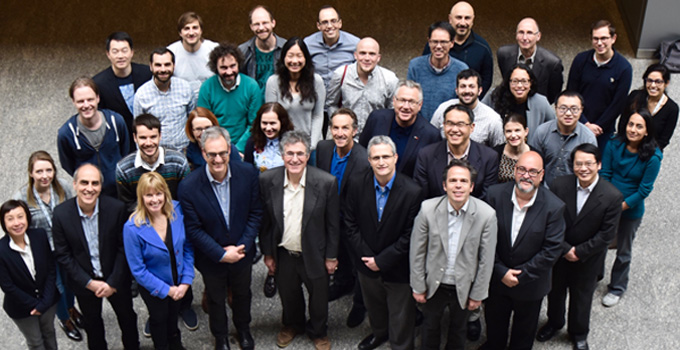
Dr. Gregory Pond, Jenna Sykes, Dr. Richard Cook, Yonathan Brhane, Dr. Wei Xu

Dr. Gregory Pond, Jenna Sykes, Dr. Richard Cook, Yonathan Brhane, Dr. Wei Xu.

Cancer researchers often confront quantitative challenges and puzzles that are best addressed by biostatisticians – specialists in a field for which there is a growing demand. In a 2008 survey of Ontario oncologists, eight in 10 respondents identified the lack of trained biostatisticians as a factor limiting their progress in cancer research. OICR has recently renewed funding for the Biostatistics Training Initiative (BTI) following a successful review. With this funding, the BTI will continue to benefit Ontario’s cancer research community and  develop the next generation of cancer biostatisticians. The BTI is run in partnership with in the University of Waterloo and McMaster University.

(more…)

Q and A with Dr. Philip Awadalla, Scientific Director of the Canadian Partnership for Tomorrow Project

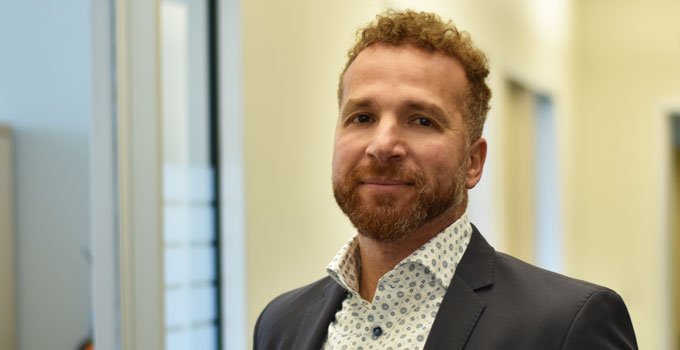
Dr. Philip Awadalla poses for a photo in a hallway

Since 2008, the Canadian Partnership for Tomorrow Project (CPTP) has collected health data and biological samples from more than 300,000 volunteer participants across Canada. Now that its primary data collection phase has concluded, the Project is sharing this data with qualified researchers to help uncover the factors behind cancer and other diseases. It was recently announced that OICR’s Dr. Philip Awadalla will serve as the Project’s National Scientific Director and that OICR will host the Project’s national database and other scientific activities. We sat down with Awadalla to learn more about his vision for CPTP’s future. (more…)

Canada’s largest health research platform teams up with University of Toronto to accelerate cancer and chronic disease research

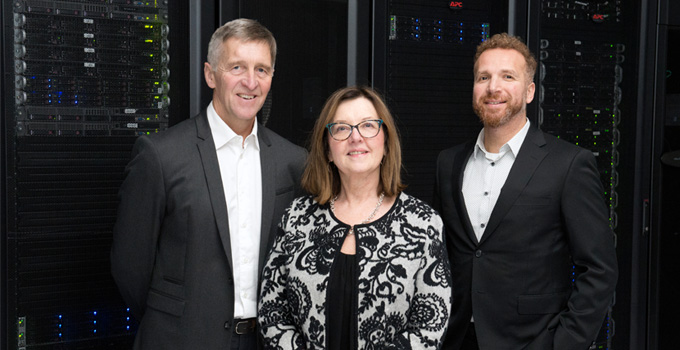
The leaders of the CPTP stand in front of servers storing the Project's data.

Pictured (left to right): Dr. John Mc Laughlin, Executive Director of CPTP; Cindy Morton, Chief Executive Officer of the Canadian Partnership Against Cancer.; and Dr. Philip Awadalla, National Scientific Director of CPTP.

Canadian Partnership for Tomorrow Project (CPTP) enters a new era of scientific activity under the leadership of newly appointed National Scientific Director, Dr. Philip Awadalla

March 29, 2018 (Toronto) – The Canadian Partnership Against Cancer (“the Partnership”) today announced The University of Toronto’s Dalla Lana School of Public Health will be the new national scientific partner of the Canadian Partnership for Tomorrow Project (CPTP) – Canada’s national population cohort for precision health. This new scientific partner will enable a strong national scientific vision for CPTP and support leading-edge research on the possible causes of cancer and chronic diseases, leading to more made-in-Canada discoveries and breakthroughs. In addition, the University has announced that Ontario Institute for Cancer Research (OICR) will be its strategic partner to deliver the expertise and services needed to lead this key research platform.

(more…)

OICR names Dr. Laszlo Radvanyi as new President and Scientific Director


A photo of the MaRS Centre with an inset photo of Dr. Laszlo Radvanyi

Following an extensive international search, I am very pleased to announce on behalf of the Board of Directors the appointment of Dr. Laszlo Radvanyi as the new President and Scientific Director of the Ontario Institute for Cancer Research (OICR) effective May 1, 2018. Dr. Radvanyi was born and raised in Toronto and obtained his PhD in Clinical Biochemistry from the University of Toronto in 1996. After obtaining his PhD, he performed post-doctoral work at Harvard University (Joslin Diabetes Center) and then worked for four years at Sanofi Pasteur Canada as a Senior Scientist in the Immunology Platform. Dr. Radvanyi brings a strong oncology research background as well as leadership experience in international pharma and small biotech. We are pleased to welcome him back to Ontario.

Dr. Radvanyi has joined OICR from EMD Serono (Merck KGaA, Darmstadt Germany) where he was a Senior Vice President, Global Senior Scientific Advisor in Immunology and Immuno-Oncology playing a central scientific advisory role, facilitating major academic center alliances, and running EMD Serono’s CAR T-cell program in partnership with Intrexon. He also served as Global Head of the Immuno-Oncology Translational Innovation Platform where he was instrumental in rebuilding immuno-oncology research at the company, hiring new world-class scientific staff as well as pruning and re-orienting the discovery pipeline.

(more…)

Collaborating to bring new treatment options to children with brain cancer

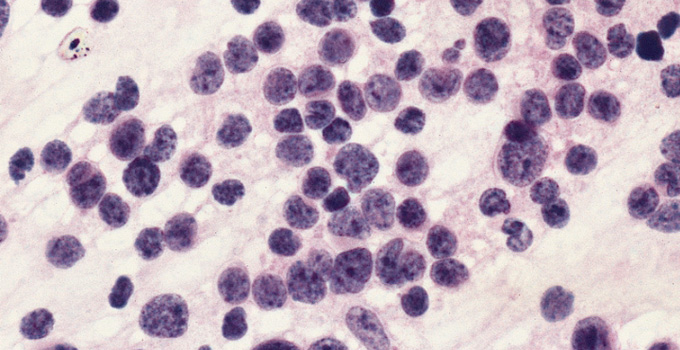
Medulloblastoma cells as seen under a microscope

OICR’s Brain Cancer Translational Research Initiative (TRI) and the Terry Fox Precision Oncology for Young People Program (PROFYLE) are partnering to share data and deliver improved treatment options to young brain cancer patients.

(more…)

Canadian pancreatic cancer research team provides personalized medicine, new hope to patients

VANCOUVER – Canadian pancreatic cancer researchers are joining forces under a Terry Fox initiative bringing new hope for patients with this deadly disease.

“For many years it’s been hopeless from a patient perspective, and we are hoping to help shift this,” says Dr. Daniel Renouf (BC Cancer, University of British Columbia) who, along with Dr. David Schaeffer (UBC, Vancouver General Hospital), is leading a $5-million pan-Canadian, precision medicine initiative recently funded by the Terry Fox Research Institute.

A lack of early detection tests. Few known symptoms. Very limited treatment options. No known biomarkers that can be used to direct therapy.  These are among the clinical challenges team EPPIC, short for Enhanced Pancreatic Cancer Profiling for Individualized Care, is tackling over the next five years to improve personalized treatments for patients with pancreatic ductal adenocarcinoma (PDAC), a disease with just a nine per cent five-year survival rate.

(more…)

Study shows that environmental exposures such as air pollution are more determinant of respiratory health than inherited genetics

Toronto (March 6, 2018) – Researchers have found strong evidence that environmental exposures, including air pollution, affect gene expressions associated with respiratory diseases much more than genetic ancestry. The study, published today in Nature Communications, analyzed more than 1.6 million data points from biological specimens, health questionnaires and environmental datasets, making this study one of the largest ever to examine the relationship between gene expression and environmental stimuli. These findings represent a groundbreaking use of big data to uncover the environmental factors that are behind diseases and inform strategies for prevention, an approach that would apply to a number of diseases, including cancer.

(more…)

Global Alliance for Genomics and Health launches 2018 Strategic Roadmap

The Global Alliance for Genomics and Health (GA4GH) has laid out its plans for the next five years as it continues to align its activities with meeting the key needs of the genomics data community. The Strategic Roadmap encompasses the standards and frameworks that will be developed by GA4GH and will be updated with new deliverables annually. OICR is a GA4GH Host Institution.

(more…)