Opening the virtual floodgates for cancer research and discovery
OICR’s Genome Informatics team announces international release of the ICGC-ARGO Data Platform, the all-in-one data hub for the largest clinical-genomic data sharing initiative in the world
We’re in the midst of an era of big data that is changing the way we understand the world – including how we study, diagnose and treat cancers.
Improvements in sequencing technology and computational power have allowed us to collect massive amounts of information about cancer patients and their tumours. This information, however, is only powerful if it can be accessed by those who can transform big data into new discoveries.
Over the last decade, OICR’s Genome Informatics has built a reputation for developing robust big data portals that provide cancer data access to thousands of researchers around the world. Now, the Genome Informatics team has set out to do it again – this time with bigger data.
CanPath Awarded $2.1 million CIHR Grant for SUPPORT-Canada COVID-19 Initiative
The SUPPORT-Canada initiative will capture data and biospecimens in order to identify factors contributing to COVID-19 susceptibility, severity and outcomes.
CanPath (the Canadian Partnership for Tomorrow’s Health), co-led by OICR Investigator Dr. Philip Awadalla, has been awarded a $2.1 million grant from the Canadian Institutes of Health Research (CIHR) through their COVID-19 Rapid Research Funding competition. The initiative, titled SUrveying Prospective Population cOhorts for COVID-19 pRevalence and ouTcomes in Canada (SUPPORT-Canada),aims to capture data and biospecimens to enable population-level surveillance. SUPPORT-Canada will enable researchers and clinicians to find factors contributing to COVID-19 susceptibility, severity and outcomes, thus identifying factors predisposing individuals or communities across Canada to a high risk of infection.
“The integration of clinical programs with our broader existing population cohort infrastructure creates the opportunity to rapidly assess patterns across Canada, while discovering and tracking critical biological and environmental determinants of disease susceptibility and severity for COVID-19,” says Awadalla, who is the lead Principal Investigator for the SUPPORT-Canada Initiative and National Scientific Director of CanPath.
A blood test to diagnose and classify tumours could be revolutionary and practice-changing for patients and clinicians alike. In many cases, a simple blood sample could take the place of more invasive surgery to obtain tissue samples – resulting in better treatment planning and less anxiety for patients.
University Health Network’s (UHN) Drs. Daniel De Carvalho and Gelareh Zadeh collaborated to combine advanced technology with machine learning to develop a highly sensitive and accurate blood test to detect and classify brain cancers. Photo Credit: UHN
In an OICR-supported study recently published in Nature Medicine, researchers have shown that a simple but sensitive blood test can accurately diagnose and classify different types of brain tumours. With further research and development, the test could serve as a less-invasive method to detect, diagnose and classify the severity of brain tumours.
The study was also presented virtually on June 22 at the Opening Plenary Session of the American Association for Cancer Research Annual Meeting 2020: Turning Science into Lifesaving Care.
Inside OICR’s Drug Discovery Lab: A graduate student’s unique collaborative experience
An open-science brain cancer drug development initiative makes for a memorable master’s experience
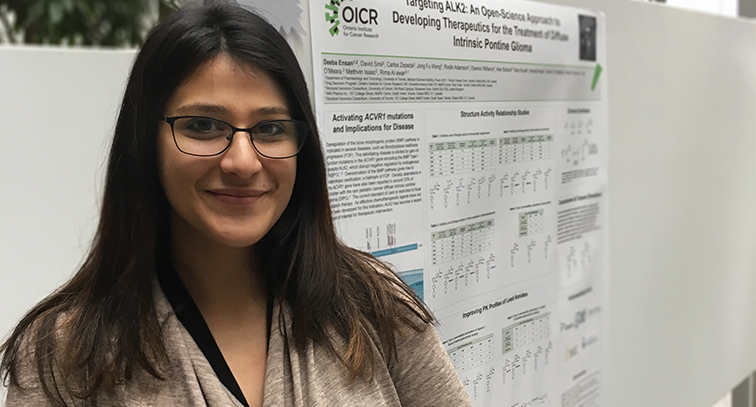
Deeba Ensan
Diffuse intrinsic pontine glioma (DIPG) is a complex, lethal and inoperable type of childhood brain cancer with a median survival of less than a year from diagnosis. Not only is DIPG difficult to treat, it is also extremely rare, making it a particularly challenging disease to study. Given this challenge, those studying DIPG have come together from around the world to find new solutions together.
When University of Toronto master’s student Deeba Ensan heard that OICR was contributing to DIPG research, she was eager to help. Over the last two years, Ensan has made considerable progress towards a new drug for DIPG.
OICR joins European consortium to ‘enable and unlock biology in the open’
OICR’s Drug Discovery Program and the Structural Genomics Consortium join Europe’s new large-scale collaboration focused on generating open-access chemical tools for disease research and drug development
Developing a new drug is a long, arduous and expensive process, requiring carefully-designed chemical compounds and the expertise to turn these compounds into medicines. In a massive international effort to accelerate this process, Europe’s Innovative Medicines Initiative (IMI) has recently launched a five-year, €66M, 22-partner consortium, EUbOPEN. OICR is a proud EUbOPEN partner.
Over the next five years, the consortium’s 22 participating organizations are teaming up to develop chemical probes and share those probes openly with the scientific community. Together, they will develop these chemical tool compounds for 1,000 proteins, representing a third of all druggable proteins in the human body.
Community-driven initiative finds new potential avenue of ovarian cancer treatment
OICR-funded researchers identify promising targets to shut down the spread of ovarian cancer
Despite new targeted therapies, ovarian cancers often spread to other organs in the body and become resistant to drugs, leading to nearly 2,000 deaths in Canada each year according to the Canadian Cancer Society. Dr. Trevor Shepherd is committed to finding new solutions for women with this disease.
In an initiative supported by local ovarian cancer survivors and philanthropic donors, Shepherd and collaborators have discovered a new way to shut down the spread of ovarian cancer. In their recent study published in Cancers, they found a molecular pathway that ovarian tumours require to spread to other organs. The study pinpoints two key proteins along this pathway – LKB1 and NUAK1 – as potential drug targets.
FACIT recognized with 2020 Venture Capital Regional Impact Award by the Canadian Venture Capital & Private Equity Association (CVCA)
Award acknowledges FACIT’s commercialization impact in growing Ontario’s life sciences industry
FACIT, a commercialization venture firm, has been nationally recognized with CVCA’s 2020 Venture Capital Regional Impact Award for Ontario. The CVCA helps to set the foundation for greater collaboration, innovation, growth and market intelligence for Canadian private capital professionals. The Venture Capital Regional Impact Award celebrates firms whose investments have positioned portfolio companies to make a meaningful mark within both their community as well as the broader niche sector. The award competition considers the most impactful private equity organizations across all sectors including IT, AgTech, Healthcare, and CleanTech.
FACIT’s award was specifically related to the 2019 historic US$1B partnership between its portfolio companies, Propellon Therapeutics (“Propellon”) and Triphase Accelerator (“Triphase”), and US pharma giant Celgene (acquired by Bristol-Myers Squibb Company). The partnership represents one of the largest oncology licensing transactions for a preclinical asset in Canadian history, and the largest biotech asset transaction worldwide for academia. Moreover, this deal helped to solidify a “made in Ontario” development pathway for commercialization of oncology innovations, as the asset at the heart of the transaction originated from FACIT’s strategic partner, the Ontario Institute for Cancer Research (OICR). FACIT’s strategic seed investment of $3M was critical in putting Ontario intellectual property (IP) in a position of strength to negotiate a transaction with maximum regional impact. The collaboration with Triphase anchors R&D jobs, clinical trials and industrial development in Ontario, benefiting both the economy and patients.
Through financial support from Ontario’s Ministry of Colleges and Universities, FACIT has a mandate to translate Ontario’s most promising cancer innovations and maximize the value of the province’s investment in research and healthcare. With a portfolio that has attracted over $850 million in investment to Ontario, FACIT is actively building companies with entrepreneurs to accelerate healthcare innovation and retain IP value, jobs and industrial development in Canada. Its success in locally commercializing medical technology, health IT, imaging, and therapeutics is a direct result of the integration of outstanding science, Ontario First seed capital, and industry experience into a novel commercialization venture model. Not only have FACIT-supported ventures attracted remarkable life science financings, but every dollar invested by FACIT has attracted $20 dollars of private equity to the province.
“We are proud of the team’s work to help demonstrate the value of seed-stage investing in the commercialization of Propellon and Triphase, and we thank CVCA for this honour and recognition by our industry peers,” said Dr. David O’Neill, President of FACIT. “The rapid growth of our portfolio demonstrates the power of biotechnology to capitalize on Ontario’s world-class cancer science, compete in the innovation economy and make a difference in the fight against cancer.”
“This is a great achievement and recognition that FACIT is successfully driving significant benefits to the Ontario innovation economy, building on the research strength of OICR,” said Dr. Laszlo Radvanyi, President and Scientific Director of OICR.
“Congratulations to FACIT on receiving the CVCA award for their leadership in Ontario’s commercialization sector,” said the Honourable Ross Romano, Minister of Colleges and Universities. “FACIT has made smart and strategic investments in Ontario’s rapidly developing biotech sector. The firm is an important partner in ensuring that the province’s intellectual property is captured, both for the local economy and patients living with cancer.”
The complexities of head and neck cancers may be simpler than we thought
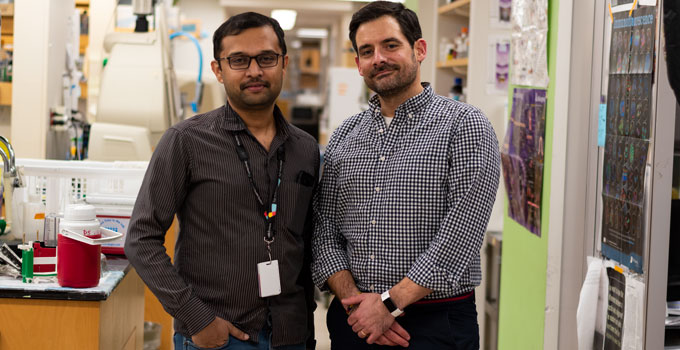
Drs. Sampath Loganathan and Daniel Schramek.
Toronto-based
research team uncovers dozens of rare mutations found in head and neck cancers converge
on a single molecular pathway, amplifying the need to shut down this critical
cancer-causing mechanism
With the advancement of DNA sequencing technology,
researchers have discovered hundreds of genes that, when mutated, can drive
cancer progression. Despite these discoveries, we don’t yet fully understand
how the majority of cancer-causing genes work, leaving a large gap between the
discovery of a gene mutation and the discovery of a new therapy. Dr. Daniel
Schramek is filling that gap.
In a recent study, published in Science, Schramek and collaborators,
including Dr. Trevor Pugh, Director of Genomics at OICR, analyzed the function
of nearly 500 gene mutations found in head and neck cancers. Remarkably, they
discovered that the many of these mutations affected one key molecular process within
cancer cells. They shut down NOTCH signaling.
“While
we see many different mutations in different genes across different patients,
we found that many mutations, surprisingly, tend to do the same thing,” says
Schramek, who is an investigator at Sinai Health’s Lunenfeld-Tanenbaum Research
Institute (LTRI). “This means the
complexities of head and neck cancers may be simpler than we thought”
Schramek
reasons that focusing on correcting the NOTCH pathway, rather than correcting
the effects of each individual gene mutation, could simplify and focus the
search for new and improved cancer therapies. He estimates that approximately
70 per cent of people with head and neck cancers have tumours that are affected
by this pathway. Thus, a large majority of these patients could benefit from NOTCH-correcting
cancer drugs.
“Every patient’s tumour is made up of different gene mutations and combinations of these mutations,” says Dr. Sampath Loganathan, first author of the study and Postdoctoral Fellow in the Schramek Lab. “Some of the more common, well-understood mutations are druggable – meaning they can be blocked with drugs – but there are hundreds of rarer, but important, mutations that we don’t yet understand.”
It is challenging to understand how a single
mutation causes damage within a cell and ultimately leads to cancer. It is tremendously
more challenging to understand the function of hundreds of mutations.
Our findings present a new way of thinking about precision oncology
Dr. Daniel Schramek
Schramek’s lab, however, developed an experimental
system that allowed them to accelerate traditional functional testing for a
fraction of the cost. Their system could test hundreds of gene mutations in a
single mouse model. What would take several millions and decades in research
and development, could now be done in one year for a fraction of the cost.
Equipped with their powerful tools, this research group was the first to
systematically look at rare mutations in head and neck cancers.
Schramek
and collaborators are now working to identify key elements within the NOTCH
pathway that can be blocked with chemicals. Their ultimate goal is to develop
these chemicals into new drugs to help those with head, neck and other types of
cancers. They will also continue to explore this phenomenon in other cancers
such as breast and pancreatic cancers.
“Our
findings present a new way of thinking about precision oncology,” Schramek
says. “Instead of matching patients with specific mutations to specific
treatments, researchers could focus on shutting down or restoring the pathways
involved with those genes – hence, a pathway-centric model of precision oncology.
We’re excited by this progress, and we look forward to bringing our ideas to
future patients.”
This research was done in collaboration with OICR and was supported by the Canadian Institutes of Health Research, the Terry Fox Research Institute and the Human Frontier of Science Program. Schramek is a Kierans/Janigan Cancer Research Scientist and holds a Canada Research Chair in functional cancer genomics in the Department of Molecular Genetics at the University of Toronto.
OICR Imaging Program co-director, Dr. Aaron Fenster, awarded
the province’s highest honour
OICR congratulates Dr. Aaron Fenster who was recently
appointed to the Order of Ontario – the province’s highest honour.
The Order of Ontario recognizes
individuals whose exceptional achievements have left a lasting legacy in the
province, in Canada and beyond.
“Members of the Order of Ontario
exemplify, individually and collectively, the best qualities of good
citizenship,” said Her Honour Elizabeth Dowdeswell, Lieutenant Governor of
Ontario. “Through their voluntary service, creativity, and the relentless
pursuit of excellence, they demonstrate how we in Ontario are working to build
a more just and sustainable future.”
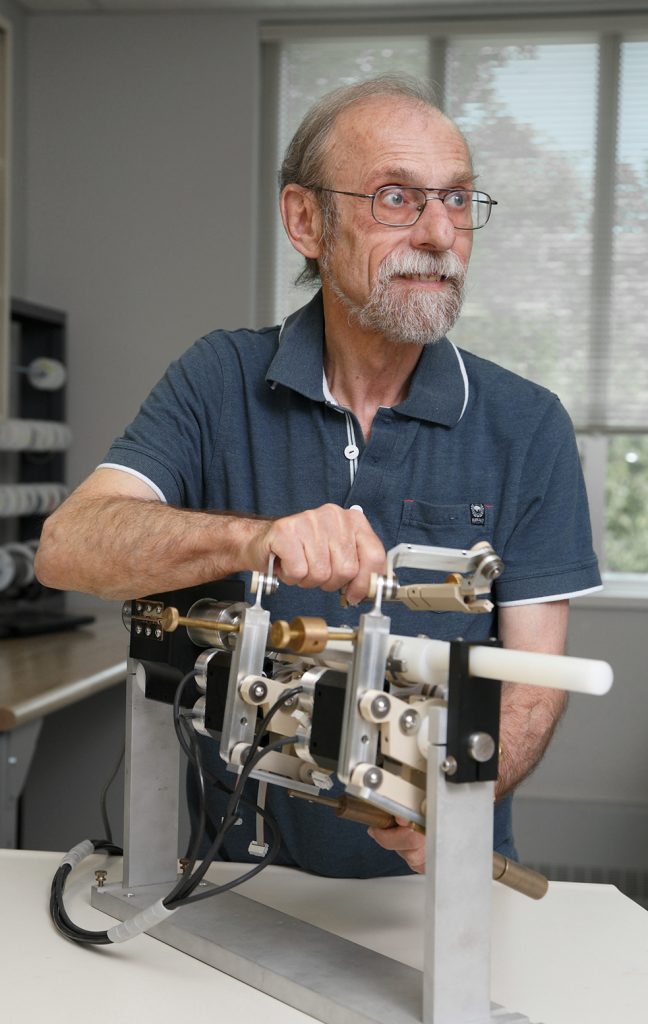
In Fenster’s case, that means developing new medical imaging technologies and the infrastructure for new inventions to help more patients, sooner. Over four decades of medical imaging research and development, Fenster has invented dozens of new techniques, systems and devices that help scientists better understand cancer and clinicians deliver better treatment.
One of his systems for ultrasound
image-guided prostate cancer treatment is in use around the world. Another one
of his image-guided systems that could improve the accuracy of gynecologic
cancer treatment is currently in clinical trials.
Fenster, who is a scientist at Robarts Research Institute and a professor at
Western University, is well-recognized in the community for his commitment to
translational research. For him, having the greatest impact on the health of
patients requires collaboration across disciplines, industries and geographies to
work on common challenges.
We work across disciplines like engineering, biology, physics and computer science, to design the best solutions. We work with clinicians, surgeons and radiologists to ensure these solutions can help patients. This is a special community.
Dr. Aaron Fenster
The programs Fenster has established, including OICR’s Imaging Program, have helped train the next generation of researchers who will continue to improve how we diagnose and treat cancers for years to come. Fenster’s imaging program in London – which he built from scratch – now includes more than 250 researchers and staff, including more than 100 graduate students.
Study reveals roots of leukemia that current chemotherapies can’t reach
Researchers find the roots of leukemia relapse are present at diagnosis, uncovering clues to new treatment approaches
Despite
significant advances in the treatment of acute lymphoblastic leukemia (ALL),
the disease often returns aggressively in many patients after treatment. It is
thought that current chemotherapies eliminate most leukemia cells, but groups
of resistant cells may survive therapy, progress and eventually cause relapse.
Dr. John Dick and collaborators have found these cells.
In a recent study published in Cancer Discovery, Dick and collaborators were able to identify and isolate groups of genetically distinct cells that drive ALL relapse.
The cells, termed
diagnosis relapse initiating (dRI) clones were found to have genetic
characteristics that differ from the other leukemia cells that are eliminated
by treatment.
The study, along with a complementary study published in Blood Cancer Discovery, unraveled the genetic, epigenetic, metabolic and pro-survival molecular pathways driving treatment resistance. Together, these papers provide an integrated genomic and functional approach to describing the underlying genetics and mechanisms of relapse for ALL.
Interestingly,
the research group discovered that dRI clones are present at diagnosis, opening
opportunities to improve treatment up-front, devise drugs that target these
resistant cells and prevent relapse from ever occurring.
Dr. Stephanie Dobson
“Our study has shown that genetic clones that contribute to disease recurrence already possess characteristics such as therapeutic tolerance that distinguish them from other clones at diagnosis,” says Dr. Stephanie Dobson, first author of the study who performed this research as a member of John Dick’s Lab. “Being able to isolate these clones at diagnosis, sometimes years prior to disease recurrence, has enabled us to begin to profile the properties allowing these particular cells to survive and act as reservoirs for relapse. This knowledge can be used to enhance our therapeutic approaches for targeting relapse and relapse-fated cells.”
“Xenografting
added considerable new insight into the evolutionary fates and patterns of
subclones obtained from diagnosis samples,” says John Dick, who is the
co-senior author of the study, Senior Scientist at the Princess Margaret Cancer
Centre and leader of OICR’s Acute Leukemia Translational Research Initiative.
“We were able to gather extensive information about the genetics of the
subclones from our models, which helped us describe the trajectories of each
subclone and the order in which they acquired mutations.”
Ordering
these mutations relied on the advanced machine learning algorithms designed by
Dr. Quaid Morris and Jeff Wintersinger at the University of Toronto.
Research
efforts are underway to build on these discoveries and determine how to block
dRI clones.
The
study was led by researchers at St. Jude Children’s Research Hospital, the
Princess Margaret Cancer Centre and the University of Toronto and supported in
part by OICR’s Acute Leukemia Translational Research Initiative.
This website uses cookies in order to optimize the user’s experience. To learn more about how we use cookies on this website, please review our Website Privacy Statement. Your browser settings may allow you to turn off cookies. By continuing to use our website site without changing your browser settings, you consent to our use of cookies in accordance with Website Privacy Statement
This website uses cookies to improve your experience while you navigate through the website. Out of these, the cookies that are categorized as necessary are stored on your browser as they are essential for the working of basic functionalities of the website. We also use third-party cookies that help us analyze and understand how you use this website. These cookies will be stored in your browser only with your consent. You also have the option to opt-out of these cookies. But opting out of some of these cookies may affect your browsing experience.
Necessary cookies are absolutely essential for the website to function properly. These cookies ensure basic functionalities and security features of the website, anonymously.
Cookie
Duration
Description
cookielawinfo-checkbox-analytics
11 months
This cookie is set by GDPR Cookie Consent plugin. The cookie is used to store the user consent for the cookies in the category "Analytics".
cookielawinfo-checkbox-functional
11 months
The cookie is set by GDPR cookie consent to record the user consent for the cookies in the category "Functional".
cookielawinfo-checkbox-necessary
11 months
This cookie is set by GDPR Cookie Consent plugin. The cookies is used to store the user consent for the cookies in the category "Necessary".
cookielawinfo-checkbox-others
11 months
This cookie is set by GDPR Cookie Consent plugin. The cookie is used to store the user consent for the cookies in the category "Other.
cookielawinfo-checkbox-performance
11 months
This cookie is set by GDPR Cookie Consent plugin. The cookie is used to store the user consent for the cookies in the category "Performance".
viewed_cookie_policy
11 months
The cookie is set by the GDPR Cookie Consent plugin and is used to store whether or not user has consented to the use of cookies. It does not store any personal data.
Functional cookies help to perform certain functionalities like sharing the content of the website on social media platforms, collect feedbacks, and other third-party features.
Performance cookies are used to understand and analyze the key performance indexes of the website which helps in delivering a better user experience for the visitors.
Analytical cookies are used to understand how visitors interact with the website. These cookies help provide information on metrics the number of visitors, bounce rate, traffic source, etc.
Advertisement cookies are used to provide visitors with relevant ads and marketing campaigns. These cookies track visitors across websites and collect information to provide customized ads.
Other uncategorized cookies are those that are being analyzed and have not been classified into a category as yet.
This website uses cookies in order to optimize the user’s experience. To learn more about how we use cookies on this website, please review our Website Privacy Statement. Your browser settings may allow you to turn off cookies. By continuing to use our website site without changing your browser settings, you consent to our use of cookies in accordance with Website Privacy Statement