
Today, a group of OICR staff members and others from the community once again took part in the Great Canadian Hair “Do” in support of The Terry Fox Foundation. Together they raised more than $10,000. Thank you to all who donated and came out to support the team. The team is still accepting online donations.
Meet our students – 2018
Meet Dike Aduluso-Nwaobasi, Sarah Donald and Benson Wan. Find out how summer co-op positions affected their career and educational journeys.
Meet the researchers: Ratheesh Subramaniam
https://www.youtube.com/watch?v=86x5mI-zinY
Ratheesh Subramaniam talks about his work in OICR’s Drug Discovery team and how it could help doctors make a difference in treating cancer patients.
Data integration for the future of precision oncology
Big data are ushering in a new era of individualized cancer care and prevention, but not without conceptual and practical challenges. Canadian advances in genomics will be made by or limited by bioinformatics analytical capacity as well as the ability to store and analyze data in new and more sophisticated ways.
To help realize the potential of genomics research in cancer, the Canadian Data Integration Centre (CDIC) platform, led by OICR, offers third generation bioinformatics and genomics tools to support both functional and clinical genomics research. CDIC is the largest academic cancer informatics program in the country – offering customizable, client-oriented access services for data challenges across diverse research areas.
Open source in open science: Accelerating cancer research (Part 2)

Find part 1 here: Open source in open science: Accelerating cancer research
OICR researchers have contributed to major open source projects available to the global research community in order to accelerate cancer research. Click the link below to read about more of OICR’s open source software projects.
Open source in open science: Accelerating cancer research (Part 1)

In the effort to bring better disease prevention and treatment to patients faster, cancer researchers are thinking more creatively about ways to conduct high-quality scientific research. Concerns about the quality, efficiency and reproducibility of research have motivated the open science movement – the growing trend of making data, methods, software and research more accessible to the greater scientific community.
Open source software (OSS), a major component of open science, enables research groups to reduce redundant efforts in software engineering by sharing software code and methods. In addition to improving efficiency, OSS promotes high-quality research by enabling collaboration, and helps make research easier to reproduce by making it more transparent.
Meet the researchers: Cheryl Crozier
https://youtu.be/fzMVk05cKKk
Cheryl Crozier talks about her work in OICR’s Diagnostic Development team and how it could help doctors make a difference in treating cancer patients.
Can an open drug discovery model find a solution for rare brain cancers in children?
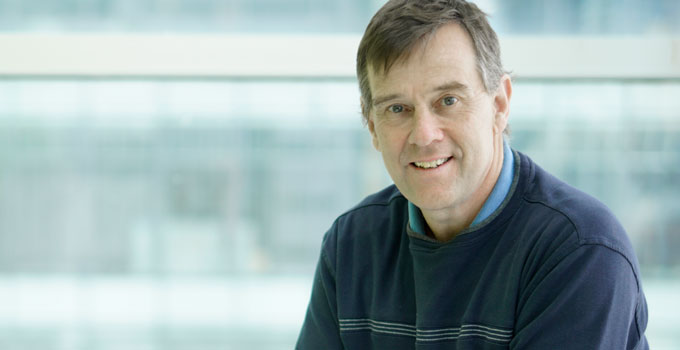
Dr. Aled Edwards
OICR-funded drug discovery project’s unique ‘open science’ business model is accelerating the search for a solution to lethal pediatric brain cancers
Diffuse intrinsic pontine glioma (DIPG) is a lethal and inoperable brain cancer with a median survival of less than a year from diagnosis. Finding solutions to this disease is challenging due to its rarity, scientific complexity and its presentation in pediatric populations. An OICR-funded team of researchers, led by Dr. Aled Edwards from M4K Pharma, have developed new potential drug candidates for DIPG that they will test in animal models in the coming months. They’ve reached this milestone ahead of schedule, with fewer resources required than anticipated, by using an ‘open drug discovery’ approach – sharing their methods and data with the greater research community to streamline the drug discovery process.
More than 300,000 Canadians enrol in multi-decade research initiative to monitor disease trends
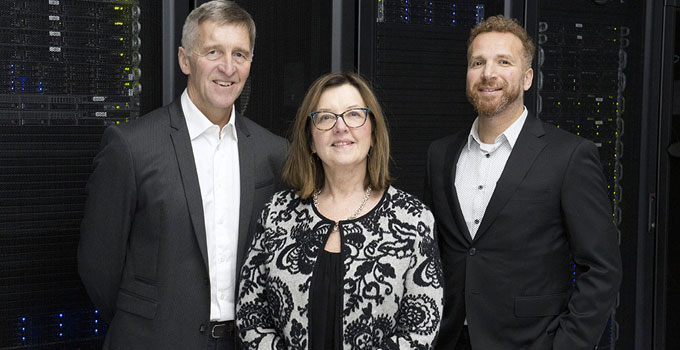
From left, Dr. John McLaughlin, executive director of CPTP, Cindy Morton, chief executive officer of the Canadian Partnership Against Cancer, and Dr. Philip Awadalla, national scientific director of CPTP
Over the past 10 years, more than 300,000 Canadians have volunteered to be part of the Canadian Partnership for Tomorrow Project (CPTP), a research platform that tracks the development of cancers and chronic diseases in the population over several decades to better understand risk factors.
Researchers from across Canada and the University of Toronto published a manuscript in the Canadian Medical Association Journal last week, marking a culmination of effort from hundreds of Canadian researchers to build the project with support from multiple national and provincial funders.
OICR’s Cancer Genome Collaboratory wins 2018 OpenStack Superuser award for contributions to the cancer research community
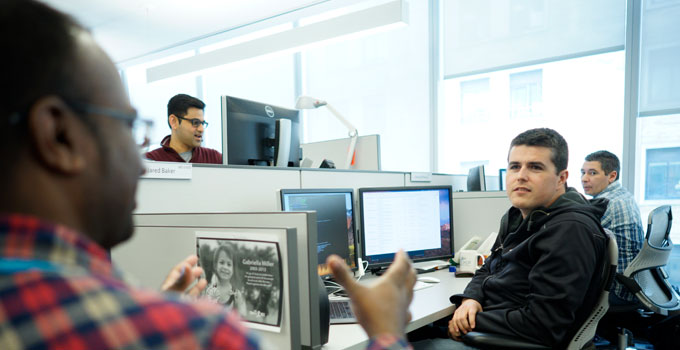
Based on popular vote and review by the Superuser Editorial Advisory Board, OICR’s Cancer Genome Collaboratory team has won the 2018 OpenStack Vancouver Summit Superuser Award. The Award recognizes OICR’s use of OpenStack, an open-source software platform for cloud computing, to enable cancer research worldwide. Previous winners of the Superuser Award include AT&T, CERN and Comcast.
“We’re proud to be recognized by the greater research community that we support,” Vincent Ferretti, Director and Senior Principal Investigator, Genome Informatics at OICR, says. “OpenStack has helped us contribute to the cancer research community in Ontario, across Canada and internationally.”