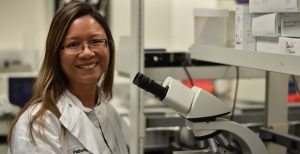
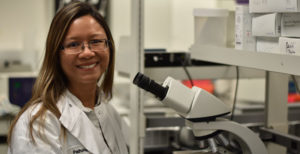
Dr. Jane Bayani

Receive the latest news, event invites, funding opportunities and more from the Ontario Institute for Cancer Research.
Dr. Bayani’s research focus is on precision medicine approaches to discover and validate biomarkers using large, well-annotated retrospective clinical and clinical trial cohorts.
Translation of biomarkers and their diagnostic platforms are key to prospective clinical trial design and successful uptake in the diagnostic setting. Critical to understanding the variable outcomes seen in the current standard of care treatment for cancers like breast and prostate is recognizing the impact of genomic heterogeneity and serves as models for discovery and translational initiatives in other cancer types. Specifically Dr. Bayani’s team investigates the impact of heterogeneity at the genomic, transcriptomic, and proteomic levels and their integration with other diagnostic testing modalities such as imaging and digital pathology to build a clinical toolbox that can to improve risk assessment and treatment decision-making. This can significantly reduce the unnecessary overtreatment of some patients, while accelerating it in others.
Heterogeneity and immune microenvironment of early invasive estrogen receptor-positive breast cancer reveal an immune-rich subset. Jain D, Liao L, Talebian V, Hopkins M, Quintayo MA, Crozier C, Bayani J, Cheung AM, Yaffe M, Bartlett J, Spears M. NPJ Breast Cancer. 2026 Mar 3. doi: 10.1038/s41523-025-00875-z. Online ahead of print.
Continuous versus Standard Palbociclib Treatment and Molecular Profiling of Solid Tissues and Liquid Biopsies in the CCTG MA.38 Trial in Advanced Breast Cancer. Joy AA, Cheng N, Gelmon KA, Mates M, Desbiens C, Clemons M, Taylor S, Lemieux J, DeLuca A, Gasparini L, Lungu I, Soave D, Fortuna A, Pugh T, Liu SS, Bartlett JMS, Awadalla P, Spears M, Chen BE, Bayani J, Parulekar WR. Cancer Res Commun. 2025 Nov 1;5(11):1998-2011. doi: 10.1158/2767-9764.CRC-25-0346.
Chronic Viral Mimicry Induction following p53 Loss Promotes Immune Evasion. Ishak CA, Marhon SA, Tchrakian N, Hodgson A, Loo Yau H, Gonzaga IM, Peralta M, Lungu IM, Gomez S, Liang SB, Shen SY, Chen R, Chen J, Chatterjee B, Wanniarachchi KN, Lee J, Zehrbach N, Hosseini A, Mehdipour P, Sun S, Solovyov A, Ettayebi I, Francis KE, He A, Wu T, Feng S, da Silva Medina T, Campos de Almeida F, Bayani J, Li J, MacDonald S, Wang Y, Garcia SS, Arthofer E, Diab N, Srivastava A, Austin PT, Sabatini PJB, Greenbaum BD, O’Brien CA, Shepherd TG, Tsao MS, Chiappinelli KB, Oza AM, Clarke BA, Rottapel R, Lheureux S, De Carvalho DD. Cancer Discov. 2025 Apr 2;15(4):793-817. doi: 10.1158/2159-8290.CD-24-0094.
Validation of the Prognostic Performance of Breast Cancer Index in Hormone Receptor-Positive Postmenopausal Breast Cancer Patients in the TEAM Trial. Bartlett JMS, Xu K, Wong J, Pond G, Zhang Y, Spears M, Salunga R, Mallon E, Taylor KJ, Hasenburg A, Markopoulos C, Dirix L, van de Velde CJH, Rea D, Schnabel CA, Treuner K, Bayani J. Clin Cancer Res. 2024 Apr 15;30(8):1509-1517. doi: 10.1158/1078-0432.CCR-23-2436.
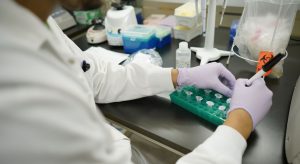
OICR’s Diagnostic Development program focuses on tissue-based analysis with expertise in formalin-fixed, paraffin-embedded (FFPE) human samples and a breadth of associated technologies for complex genome analysis, nucleic acid and protein extraction, tissue microarray construction, NanoString technologies, automated immunohistochemistry and quantitative molecular pathology analysis.
Services available:
To learn how Diagnostic Development can help further your project please contact the team at diagnostic.development@oicr.on.ca.