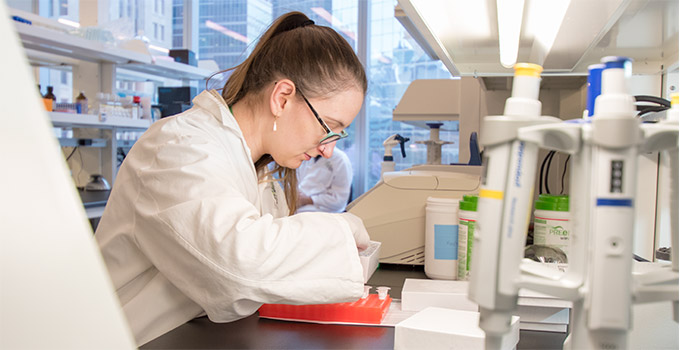
First-in-class drug for blood cancers discovered by Ontario researchers receives record-setting industry investment
Years of hard work by OICR’s Drug Discovery group and Ontario partners
moves potential new treatment for leukemia towards clinical trials
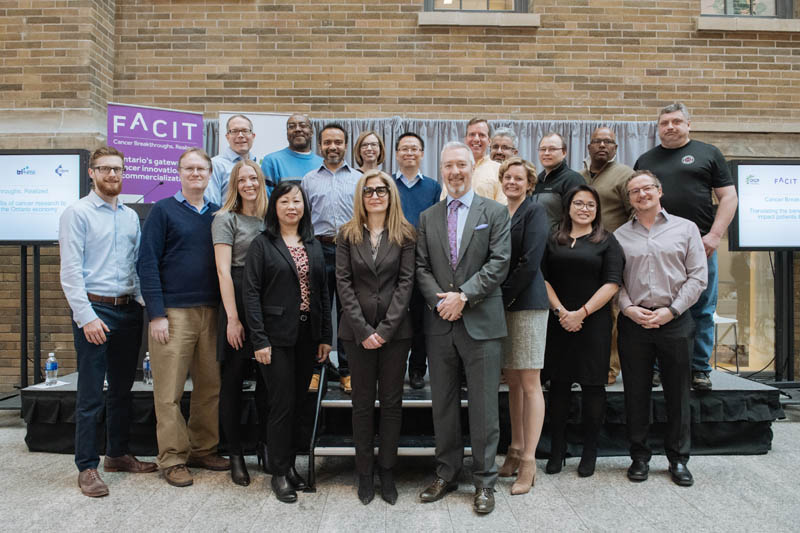
On January 29, 2019, Celgene Corporation made an
investment of up to US$1 billion that will facilitate further research and
development of the potential drug and support clinical trials in Ontario. The
potential drug was designed to exploit a weakness in leukemia centred on the
protein WDR5 that was discovered by Ontario researchers. If all options under the investment are
exercised, the deal will be the largest transaction to date for a preclinical
asset discovered in Canada.
“The progress of
this pre-clinical drug towards the clinic is an example of how OICR, working
with its partners, is accelerating cancer research in Ontario and increasing
investment so that new innovations can help patients as soon as possible,” says
Dr. Laszlo Radvanyi, President and Scientific Director of OICR. “This
announcement shows how OICR and FACIT’s unique model for research and
commercialization can generate long-term impact for the province of Ontario.” FACIT
is OICR’s strategic commercialization partner.
The WDR5 project’s development demonstrates the
unique expertise of OICR DD, the advantages to the OICR-FACIT model, and how
OICR effectively harnesses the strengths of Ontario’s diverse cancer research
ecosystem by collaborating with groups such as the Structural Genomics
Consortium (SGC), the group that initially identified the potential of
targeting WDR5 as a treatment for cancer.
Study reveals mechanism driving spread of advanced pancreatic cancer
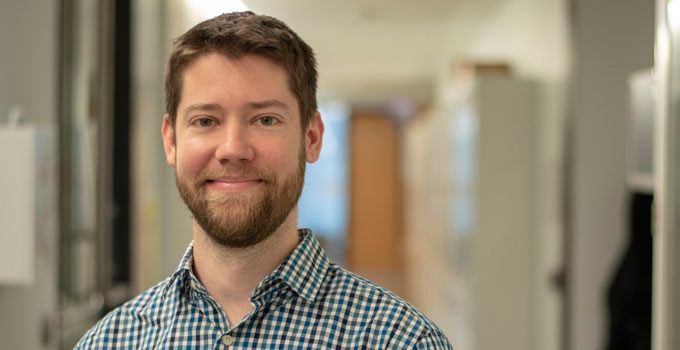
Rob Denroche, bioinformatician and Project Leader of PanCuRx.
Large-scale
pancreatic cancer study distinguishes primary from metastatic tumours, uncovering
new genomic biomarkers that could help guide treatment selection
Over the next decade, pancreatic ductal adenocarcinoma (PDAC) – the most common type of pancreatic cancer – is projected to become the second leading cause of all cancer mortality. A better understanding of how PDAC changes when it metastasizes – or spreads from the pancreas to other organs – may help researchers find ways to treat the disease more effectively.
A study by OICR researchers and collaborators, published today in Cancer Cell, showed that the cells in advanced pancreatic tumours grow – or cycle – faster than those in early tumours, revealing one of the key reasons that the disease can advance so quickly. OICR’s Pancreatic Cancer Translational Research Initiative, PanCuRx, investigated the whole genomes and transcriptomes of more than 300 PDAC tumours, contrasting cells from primary tumours and cells from metastatic tumours. This distinction may help clinicians advise patients about treatment, whether it be surgery, chemotherapy or radiation.
“Often, a patient’s primary pancreatic cancer recurs
after surgery and chemotherapy, and there is limited knowledge of metastases to
guide the next course of action. In less common ‘metachronous’ cases, treatment
depends on whether the second tumour is new, or if it grew from remnants of a
previous tumour,” says Dr. Ashton Connor, chief resident in the General Surgery
training program at the University of Toronto and lead author of the study. “In
this study, we explored differences between primary and metastatic tumours in
the hopes of better understanding the mechanisms of cancer cell spread from the
pancreas, and to ultimately inform their treatment.”
Over the last decade, PanCuRx has assembled the
largest collection of genomic and transcriptomic data on primary and metastatic
PDAC tumours. The initiative continues to collect samples through the COMPASS
clinical trial today.
“There have been very few studies of advanced
PDAC, so our rich dataset is very valuable to the future of pancreatic cancer
research,” says Rob Denroche, bioinformatician, Project Leader of PanCuRx and co-author
of the study. “Research groups from Germany, Brazil, Japan and across North
America have been interested in the data that we’ve collected and we’re happy to
enable their discoveries.”
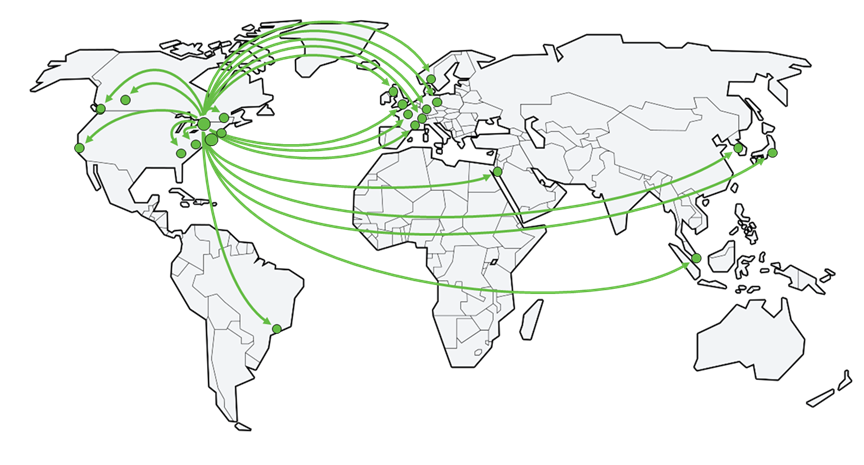
PanCuRx collaborations span four continents, largely due to their enriched dataset on metastatic PDAC.
Through COMPASS, PanCuRx will continue to build
on these findings and test if cell progression could be used to inform
treatment selection in the clinic.
“This work is foundational to
our understanding of advanced pancreatic cancer,” says
Dr. Steven Gallinger, PanCuRx Director and Head
of the Hepatobiliary/Pancreatic Surgical Oncology Program at UHN and Mount
Sinai Hospital. “We look forward to building on this understanding to better
inform treatment selection for those with this terrible disease.”
Powering the future of pathology
Ontario Molecular Pathology Research Network (OMPRN) helps establish new training standards for pathologists across Canada
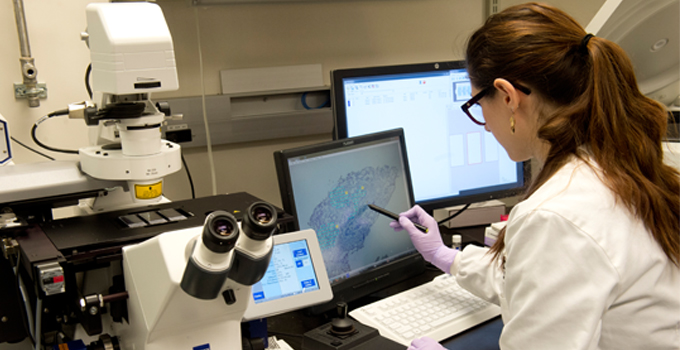
Personalized medicine presents a tremendous opportunity for molecular pathologists to contribute to improvements in detecting, diagnosing and selecting treatments for cancer patients. As new diagnostic and prognostic tools continue to emerge, it is becoming increasingly important for pathologists to engage in cancer research and understand new developments across scientific disciplines. Fostering this engagement begins with education.
OMPRN is championing the advancement of molecular pathology training across Canada through its engagement with the Royal College of Physicians and Surgeons of Canada (Royal College), Canada’s governing body for medical education. Together, they are developing a new curriculum for pathology residents based on competencies – the proficiency or ability to perform a skill – rather than the traditional time-based training approach where residents are evaluated based on the amount of time spent acquiring knowledge or practicing a skill.
Dr. David LeBrun, Principal Investigator at Queen’s Cancer Research Institute and Leader of OMPRN.
“The existing competencies around molecular pathology were not adequate in detail, nor were they adequate in rigour,” says Dr. David LeBrun, Principal Investigator at Queen’s Cancer Research Institute and Leader of OMPRN. “So we harnessed the opportunity to improve these training standards for the future of pathology in Canada.”
OMPRN developed a list of molecular pathology competencies, priorities and training strategies to inform a new national curriculum. These suggestions were presented to the Anatomical Pathology Specialty Committee of the Royal College, who accepted several of the proposed strategies and recognized OMPRN’s submission as an official Royal College Curricular Document – a curriculum guide for educators.
One of OMPRN’s major contributions to the new curriculum, which is currently being implemented across Canada, was a competency focused on synthesizing a unified, clinically-actionable report based on results from non-traditional diagnostic tests, such as liquid biopsies or genomic profiling. With this ability, pathologists can better inform clinicians while ensuring that there are no opportunities missed in the detection or diagnosis a patient’s disease.
“With proper training, pathologists can play a key role in bringing the benefits of new research discoveries into the patient experience,” says LeBrun. “These competencies will help ensure that treatment decisions in the clinic are well informed by both conventional pathology techniques and novel tools and resources.”
One of the key challenges of competency-based education is that some training centres may not have the expertise to train their residents on highly-specialized skills. OMPRN is working to address the gap in expertise by developing online education materials to complement the molecular pathology competencies and offering training courses like their inaugural Applied Molecular Pathology Course, which was held January 9-10 in Mississauga.
“Our mission is to create a vibrant community of cancer research-oriented pathologists in Ontario,” says LeBrun. “Through our educational initiatives, OMPRN is helping to build the next generation of pathologists and – in turn – driving the future of cancer innovation.”
For more information on the Ontario Molecular Pathology Research Network, please visit its website.
Learn more about the Royal College’s Competence by Design program in the video below.
OICR’s Dr. Ann Meyer receives Community Engagement Fellowship from AAAS to advance Canada’s bioinformatics community
On January 3, 23 community engagement professionals – including OICR’s Dr. Ann Meyer – were named AAAS Community Engagement fellows for 2019.
The Community Engagement Fellowship Program (CEFP) brings together professionals from a diverse range of scientific communities to share insights and develop strategies to strengthen their respective communities. CEFP aims to improve collaboration and community building in science – and that’s exactly what Meyer will continue to do in Canada’s bioinformatics space.
“Over the last few years, we’ve been working on filling the educational needs of Canada’s bioinformatics community,” says Meyer, Knowledge and Research Exchange Manager at OICR and Manager of Bioinformatics Education at bioinformatics.ca. “This fellowship will help us expand our efforts to foster and strengthen ongoing collaboration amongst research groups in Canada with similar interests.”
Meyer is the only individual from a Canadian institute who has been selected to participate in the CEFP since its inception. The 2019 cohort includes community leaders from the Chan Zuckerberg Science Initiative, the National Geographic Society and the Data Commons Pilot Phase Consortium.
“Alongside these talented community managers, I hope to bring back new techniques to better engage the bioinformatics community,” says Meyer. “Further developing our community will facilitate ongoing learning collaborations and strengthen this research network across our geographically disperse nation.”
An inside look at OICR’s Tissue Portal
In this video, Cheryl and Ilinca from OICR’s Diagnostic Development program take you inside OICR’s Tissue Portal, which processes tissue samples to ensure that researchers get the most out of these finite resources. To access this service please contact tissue.portal@oicr.on.ca.
FACIT makes follow-on investment in AI-based genomics company, DNAstack
Capital leverages Ontario’s strengths in genomics and informatics, deepens FACIT’s tech portfolio
A message from Dr. Laszlo Radvanyi, OICR’s President and Scientific Director:
“On behalf of OICR I would like to express our sincere condolences to all those affected by the flight PS752 tragedy in Iran. Many of those who were lost were students and researchers at Canadian universities, making great contributions to cancer research and other fields by passionately applying their talents to tackle society’s greatest challenges. Our thoughts are with our university partners and their communities during this difficult time.”
When it comes to finding cancer risk, there’s power in numbers
Dr. Syed Hassan Zaidi, Scientist at OICR and co-author of the study.
Large-scale genomic study discovers 40 new genetic variants associated with colorectal cancer risk
The most comprehensive genome-wide association study of colorectal cancer risk to date has discovered 40 new genetic variants and validated 55 previously identified variants that signal an increased risk of colon cancer. The study, recently published in Nature Genetics, is a product of the world’s largest molecular genetic consortium for colorectal cancer – the Genetics and Epidemiology of Colorectal Cancer Consortium (GECCO) – which was established nearly 10 years ago.
Pan-Canadian radiotherapy group advancing care by reducing barriers to conducting clinical trials
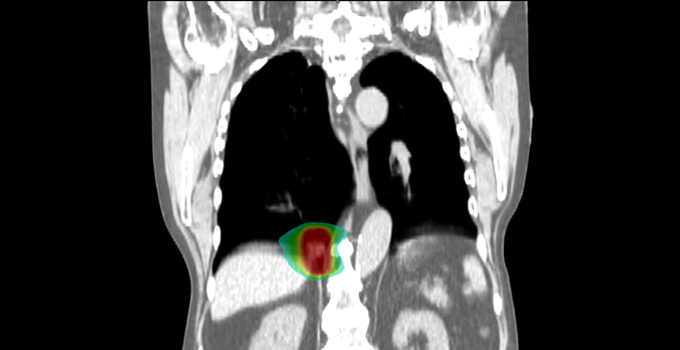
Stereotactic radiation for treatment of a lung cancer: This precise technique delivers high doses of very conformal radiation in only a few sessions and is being tested in a CAPRI trial. Areas receiving high doses of radiation are shown in red, and lower doses of radiation are shown in blue.
As a radiation oncologist at the London Health Sciences Centre, Dr. David Palma is on the front lines of treating cancer patients with radiotherapy. Despite huge advances in radiation technology over the past few decades, Palma and his colleagues have noticed that clinical trials proving the benefits of these new technologies are not keeping pace – meaning these advances are not always reaching patients. To overcome these challenges and advance treatment, Palma formed the Canadian Pulmonary Radiotherapy Investigators Group (CAPRI) to support radiotherapy clinical trials and get them up and running as quickly as possible.
What can we gain from looking at the outliers?: An investigation into long and short-term ovarian cancer survivors
Researchers investigate the clinical, molecular and microenvironment factors that contribute to extreme therapy response and resistance in ovarian cancer patients
Some patients with high-grade serous ovarian cancer (HGSOC) respond exceptionally well to therapy, while others experience rapid disease relapse. The mechanisms behind these disparate outcomes are poorly understood, but a group of researchers based at the Princess Margaret Cancer Centre (PM) supported by OICR’s Ovarian Cancer Translational Research Initiative (TRI) are working to change that.
This website uses cookies in order to optimize the user’s experience. To learn more about how we use cookies on this website, please review our Website Privacy Statement. Your browser settings may allow you to turn off cookies. By continuing to use our website site without changing your browser settings, you consent to our use of cookies in accordance with Website Privacy Statement
This website uses cookies to improve your experience while you navigate through the website. Out of these, the cookies that are categorized as necessary are stored on your browser as they are essential for the working of basic functionalities of the website. We also use third-party cookies that help us analyze and understand how you use this website. These cookies will be stored in your browser only with your consent. You also have the option to opt-out of these cookies. But opting out of some of these cookies may affect your browsing experience.
Necessary cookies are absolutely essential for the website to function properly. These cookies ensure basic functionalities and security features of the website, anonymously.
Cookie
Duration
Description
cookielawinfo-checkbox-analytics
11 months
This cookie is set by GDPR Cookie Consent plugin. The cookie is used to store the user consent for the cookies in the category "Analytics".
cookielawinfo-checkbox-functional
11 months
The cookie is set by GDPR cookie consent to record the user consent for the cookies in the category "Functional".
cookielawinfo-checkbox-necessary
11 months
This cookie is set by GDPR Cookie Consent plugin. The cookies is used to store the user consent for the cookies in the category "Necessary".
cookielawinfo-checkbox-others
11 months
This cookie is set by GDPR Cookie Consent plugin. The cookie is used to store the user consent for the cookies in the category "Other.
cookielawinfo-checkbox-performance
11 months
This cookie is set by GDPR Cookie Consent plugin. The cookie is used to store the user consent for the cookies in the category "Performance".
viewed_cookie_policy
11 months
The cookie is set by the GDPR Cookie Consent plugin and is used to store whether or not user has consented to the use of cookies. It does not store any personal data.
Functional cookies help to perform certain functionalities like sharing the content of the website on social media platforms, collect feedbacks, and other third-party features.
Performance cookies are used to understand and analyze the key performance indexes of the website which helps in delivering a better user experience for the visitors.
Analytical cookies are used to understand how visitors interact with the website. These cookies help provide information on metrics the number of visitors, bounce rate, traffic source, etc.
Advertisement cookies are used to provide visitors with relevant ads and marketing campaigns. These cookies track visitors across websites and collect information to provide customized ads.
Other uncategorized cookies are those that are being analyzed and have not been classified into a category as yet.
This website uses cookies in order to optimize the user’s experience. To learn more about how we use cookies on this website, please review our Website Privacy Statement. Your browser settings may allow you to turn off cookies. By continuing to use our website site without changing your browser settings, you consent to our use of cookies in accordance with Website Privacy Statement