
 In 2006 Dr. Martin Yaffe’s lab at Sunnybrook Research Institute developed a new way of preparing whole-mount sections of breast tissue, which opened up the exciting possibility of correlating pathology directly with medical imaging. However, the huge images that were produced posed a significant challenge to researchers; existing software for viewing images was either incapable of handling the large multi-scale images or it was too expensive and inflexible. To address these issues, Dr. Anne Martel, currently Chief Scientific Officer and co-founder of Pathcore, developed a new technology with funding assistance from OICR.
International Cancer Genome Consortium for Medicine (ICGCmed) launches today, will link genomics to clinical information and health
 New Orleans – (April 17, 2016) The International Cancer Genome Consortium (ICGC) today announced plans to launch the International Cancer Genome Consortium for Medicine (ICGCmed), a new phase in the Consortium’s evolution that will link genomics to clinical information and health.
The collaborative project will build upon the vast database of genomic discoveries of the ICGC, which, since its launch in 2007, has been mapping 25,000 different cancer genomes in 50 different tumour types and making this data freely available to qualified researchers around the world.
Dr. John Dick elected as 2016 Fellow of the AACR Academy
Toronto (April 6, 2016) – Dr. Tom Hudson, President and Scientific Director of the Ontario Institute for Cancer Research (OICR) today congratulated Dr. John Dick on receiving the prestigious honour of being one of 11 newly elected Fellows to the AACR (American Association for Cancer Research) Academy.
Dr. Dick is a Canada Research Chair in Stem Cell Biology and Senior Scientist at the University Health Network’s Princess Margaret Cancer Centre and McEwen Centre for Regenerative Medicine and Director of the Cancer Stem Cell Program at OICR.
Dana-Farber Cancer Institute and Ontario Institute for Cancer Research join Collaborative Cancer Cloud
Two leading cancer centers join effort to securely share genomic, imaging and clinical data to better understand the root causes of cancer and accelerate potentially lifesaving discoveries
PORTLAND, Ore. – The Knight Cancer Institute at Oregon Health & Science University and Intel Corporation are expanding participation in the Collaborative Cancer Cloud, a distributed precision medicine analytics platform, to include Dana-Farber Cancer Institute and Ontario Institute for Cancer Research. The institutions will join the OHSU Knight Cancer Institute in leveraging Intel’s technology to securely share and analyze their collectively large amounts of data, while preserving the privacy and security of patient data at each site.
FACIT invests in new CPDC spin-out company to aid development of potent radiotherapeutic
 In December, the Fight Against Cancer Innovation Trust invested in Fusion Pharmaceuticals to assist in the development of FPX-01, a potent new alpha-emitting radiotherapeutic being developed in Hamilton, Ontario. Early testing has shown a great deal of promise: the drug has the cancer-cell killing power of existing, similar treatments, but balances this strength with far more precision, meaning fewer side effects for patients. Early results from a Phase I clinical trial have shown effectiveness in patients with solid tumours. FACIT’s investment will support the efforts to advance FPX-01 into Phase I/II clinical trials.
New ICGC-TCGA DREAM Challenge crowd-sourced competition to help better understand how cancers evolve
 On November 16 the ICGC-TCGA DREAM Challenge launched a new crowd-sourced competition to better understand how cancer originates and evolves. It is the first project in the world to bring together crowd-sourced benchmarking and cloud-based execution of DNA sequencing analysis pipelines in an effort to improve the understanding of tumour DNA.
International Cancer Genome Consortium reaches milestone of 1,000 authorized users
TORONTO, March 1, 2016 /CNW/ – The International Cancer Genome Consortium (ICGC) announced today that its Data Access Compliance Office (DACO) authorized its 1,000th user, giving them access to the Consortium’s Controlled Access datasets. This means that more authorized researchers than ever before are accessing ICGC’s Controlled Access data for their research and using these datasets as the foundation for the next generation of cancer diagnostics and treatments.
ICGC datasets that catalogue tumour-specific mutations are unrestricted and freely available to the scientific community. However, the ICGC developed an authorization process to distribute clinical and inherited genetic data associated with unique individuals in order to minimize the risk of identification of donors based on computer analyses of demographic, clinical or genetic data.
Biostatistics Training Initiative Kick Off
This meeting sets stage for next four years of biostatistics training
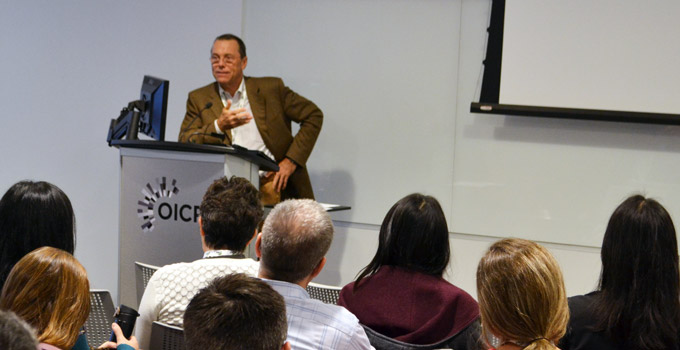
As the cancer research landscape rapidly changes, so to do the needs of hospitals and research institutes for the types of young researchers on their teams. New technological advances have led to the need for qualified biostatisticians who can work with the large amounts of data that are now an essential part of many cancer research projects.
ICGC and Amazon Web Services are bringing more genomic health data to researchers in the cloud
 The International Cancer Genome Consortium (ICGC) took another major step into the cloud last month, joining forces with Amazon Web Services (AWS) to bring 1,200 encrypted whole genome sequences to more researchers worldwide.
This means that one of the world’s largest collections of cancer genome data is now more easily accessible to qualified researchers, potentially accelerating the development of new treatments for cancer patients.
Open source cancer research
Doing things differently: The story behind the promising chemical probe developed by OICR and the Structural Genomics Consortium
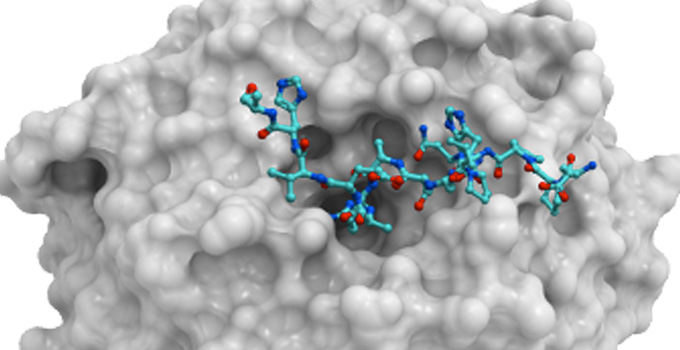
A recent collaboration between researchers at OICR and the Structural Genomics Consortium (SGC) used a new open-source approach to early stage drug discovery to develop and share without restrictions a drug-like molecule (or chemical probe) called OICR-9429 in an effort to crowd-source cancer research. OICR-9429 specifically inhibits a protein called WDR5 and can be used to investigate its function in a cell.
“Testing a new cancer treatment takes significant time and resources and unfortunately many attempts fail late in the development process. Also, most of the research activities are carried out in parallel and without enough collaboration. This leads to the duplication of a great amount of effort and raises the cost of cancer drugs that do make it to the clinic,” explains Dr. Cheryl Arrowsmith, Chief Scientist at SGC Toronto.